History
Hewlett-Packard (HP) was founded in 1939 in Palo Alto, California, by William (Bill) Hewlett and David Packard. The company began by producing electronic test and measurement instruments and over subsequent decades grew into computing, instruments, and peripherals.
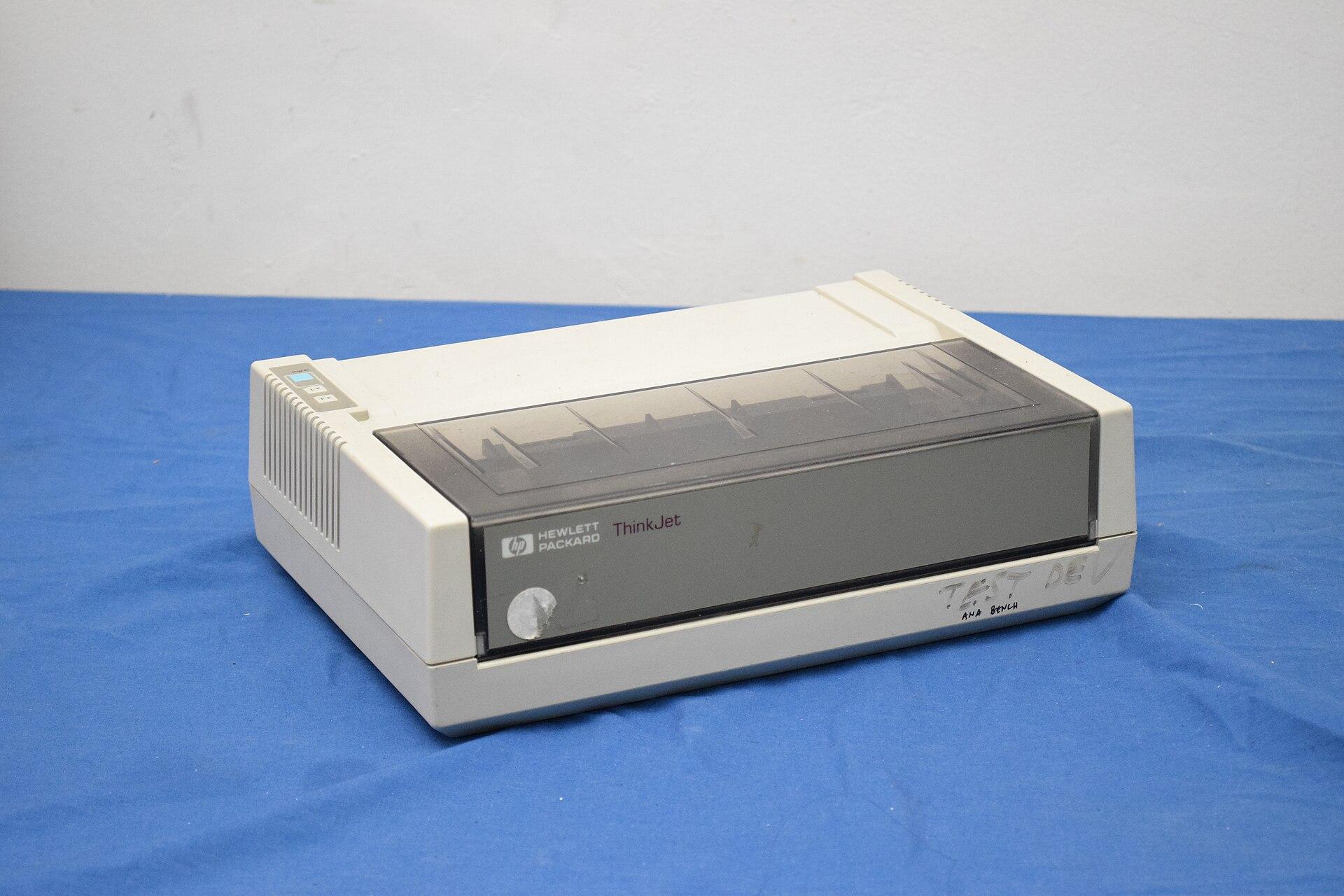
HP's move into mass-market printing came in the early 1980s from work in its laboratories on thermal inkjet technology — an effect in which a thin-film heating element superheats a nearby fluid and ejects a droplet, which HP developed into a practical printing method. HP introduced the ThinkJet (a contraction of "Thermal Ink Jet") in 1984, and the same year introduced the LaserJet, a desktop laser printer built around a Canon-supplied print engine and controlled by HP's own Printer Command Language (PCL). In 1988 HP launched the DeskJet, bringing plain-paper inkjet printing to a broad consumer and office market.
Through the 1990s and 2000s HP built a large printing and imaging franchise spanning consumer inkjet, office and enterprise laser, and — via the acquisition of Indigo N.V. and the development of PageWide — commercial and industrial digital printing. In 2015 Hewlett-Packard Company split into two independent, publicly traded companies: HP Inc. (personal systems and printing) and Hewlett Packard Enterprise (enterprise infrastructure, software, and services).
Timeline
1939
Hewlett-Packard founded in Palo Alto, California, by Bill Hewlett and David Packard.
1984
HP introduces the ThinkJet (HP 2225), an early thermal inkjet printer.
May 22, 1984
HP introduces the LaserJet at the Computer Dealers' Exhibition (COMDEX). Built on the Canon CX print engine, it offered 300 dpi at 8 pages per minute and was described as the world's first desktop laser printer.
1988
HP introduces the first DeskJet, a plain-paper thermal inkjet printer offering roughly 300 dpi at about 2 pages per minute.
1993
Indigo (later acquired by HP) launches the E-Print 1000 digital press, based on liquid electrophotography (LEP) and ElectroInk; the company was founded by Benny Landa.
2000
HP makes an initial investment in Indigo N.V.
September 6, 2001
HP announces the acquisition of the remaining shares of Indigo N.V.; the graphic-arts digital press line becomes the HP Indigo Division.
2007
HP first applies PageWide (stationary page-wide printhead) technology in a high-volume office product, the HP CM8060 / Edgeline generation.
November 1, 2015
Hewlett-Packard Company separates into HP Inc. and Hewlett Packard Enterprise; regular trading in Hewlett Packard Enterprise shares began November 2, 2015.

Printing technologies
- Thermal inkjet (Thermal Ink Jet). HP's core inkjet method, in which a thin-film heating element vaporizes ink to eject a droplet. Introduced commercially in the ThinkJet and matured in the DeskJet line.
- Laser electrophotography. Used in the LaserJet line; the first LaserJet used the Canon CX laser print engine. HP paired the engine with its own control language rather than developing an engine of its own at the outset.
- Printer Command Language (PCL). HP's page/printer control language, developed in-house and used to drive LaserJet (and other) printers; a widely adopted alternative to Adobe PostScript. The first LaserJet was controlled via PCL.
- PageWide technology. A fixed, page-wide printhead spanning the full paper width with a large nozzle count, enabling single-pass, high-speed printing without a traversing carriage.
- Liquid electrophotography (LEP) / ElectroInk. The technology underpinning HP Indigo digital presses, using electrostatically charged liquid ink on a photoreceptor; it originated with Indigo (Benny Landa) and its E-Print 1000 digital press.
Major printer families
- ThinkJet (HP 2225) — early thermal inkjet printer, 1984.
- DeskJet — plain-paper thermal inkjet line for home and small-office use, introduced 1988.
- LaserJet — desktop laser printer line, introduced 1984.
- OfficeJet — later multifunction inkjet line for consumer and office use.
- PageWide — office devices and PageWide XL wide-format lines using the page-wide printhead architecture.
- HP Indigo — digital commercial presses based on liquid electrophotography.
- HP Scitex — industrial and wide-format presses from later graphic-arts acquisitions.
Introduction dates for the OfficeJet, PageWide XL, and Scitex-branded lines are documented product-line names but were not pinned to specific verified years in the source material and are therefore left without dates.
Product areas
- Consumer. Home and small-office printing via the DeskJet and later inkjet all-in-one lines.
- Enterprise / office. LaserJet office and workgroup printers, PageWide office devices, and multifunction devices.
- Industrial / commercial (graphic arts). HP Indigo digital presses, Scitex-branded industrial and wide-format presses, and PageWide XL wide-format printing.
- Multifunction. HP produced multifunction devices combining print, scan, copy, and fax functions (commonly under OfficeJet and LaserJet MFP branding); specific early product details are not covered here.
Major innovations
- Commercialization of thermal inkjet printing for the mass market (ThinkJet, then DeskJet), making non-impact, relatively quiet, plain-paper printing affordable.
- Bringing desktop laser printing to personal computers with the LaserJet, pairing the Canon CX engine with HP's PCL. The LaserJet reached the market ahead of, and at a lower price than, the PostScript-based Apple LaserWriter, which used the same Canon engine.
- Development and broad adoption of PCL as a printer control language and a widely supported alternative to PostScript.
- PageWide stationary-printhead architecture for single-pass, high-speed printing.
- Acquisition and scaling of Indigo's liquid electrophotography digital-press technology for commercial print.
Influence on printing history
HP's printing business helped define two of the dominant paradigms of end-user printing. Thermal inkjet, embodied in the DeskJet, made color and plain-paper printing broadly accessible to consumers and small offices, while the LaserJet established the desktop laser printer as a standard for crisp, fast office document output.
HP's decision to use a Canon-built engine together with its own PCL let it reach the market quickly and at lower cost than competing PostScript-based systems, and PCL became a de facto standard supported across the industry. Later, PageWide and the HP Indigo digital-press line extended HP's influence into high-volume office and commercial and industrial printing.
Relationships with other manufacturers
- Canon. HP's LaserJet used a Canon-built laser print engine; the first LaserJet used the Canon CX engine. This engine-supply relationship was foundational to HP's laser printer business.
- Apple. A parallel competitor in early desktop laser printing. Apple's LaserWriter used the same Canon CX engine but adopted Adobe PostScript rather than HP's PCL, and shipped later and at a higher price than the LaserJet.
- Adobe. Provider of PostScript, the page-description language against which HP's PCL competed and which HP later also supported in various products.
- Indigo N.V. (Benny Landa) and other graphic-arts firms. HP acquired Indigo (digital presses) and later expanded its industrial printing through additional graphic-arts acquisitions, including Scitex-related press technologies.
Legacy technologies
Several HP printing technologies are historically significant milestones. The ThinkJet (HP 2225) was HP's first commercial thermal inkjet product, demonstrating a non-impact printing method that the company would refine over the following years. The original LaserJet, using the Canon CX engine at 300 dpi and 8 pages per minute, established the template for the desktop laser printer. PCL, developed alongside the LaserJet, became a long-lived and widely implemented printer control language. Indigo's E-Print 1000 (1993) introduced the liquid electrophotography and ElectroInk approach that HP later scaled across its commercial digital-press line.
Current status
The printing business today operates under HP Inc., one of the two companies created by the 2015 separation of Hewlett-Packard Company (the other being Hewlett Packard Enterprise). HP Inc. continues the LaserJet, DeskJet/OfficeJet, PageWide, and HP Indigo and industrial printing lines. Product-level details of the current lineup are outside the scope of this historical overview and are intentionally omitted.
Frequently asked questions
- When did HP introduce the LaserJet?
- HP introduced the LaserJet on May 22, 1984, at the Computer Dealers' Exhibition (COMDEX). It used the Canon CX print engine, offered 300 dpi at 8 pages per minute, and was described as the world's first desktop laser printer.
- What is the difference between HP's LaserJet and Apple's LaserWriter?
- Both used the same Canon CX print engine, but the HP LaserJet was driven by HP's own Printer Command Language (PCL), while Apple's LaserWriter used Adobe PostScript. The LaserJet reached the market earlier and at a lower price.
- What is PCL?
- Printer Command Language (PCL) is HP's page and printer control language, developed in-house and used to drive the LaserJet and other printers. It became a widely adopted alternative to Adobe PostScript.
- What technology do HP Indigo presses use?
- HP Indigo digital presses use liquid electrophotography (LEP) with ElectroInk, an electrostatically charged liquid ink applied to a photoreceptor. The technology originated with Indigo, founded by Benny Landa, whose E-Print 1000 launched in 1993.
- What happened to Hewlett-Packard in 2015?
- On November 1, 2015, Hewlett-Packard Company separated into two independent public companies: HP Inc., which continues the personal systems and printing businesses, and Hewlett Packard Enterprise, which covers enterprise infrastructure, software, and services.
Source transparency (14 sources)
These references support claims made in this entry. The archive uses verified institutional and public-domain sources only; see Source policy.
Sources consulted (14)
- HP LaserJet — Wikipedia
- HP DeskJet — Wikipedia
- HP Indigo Division — Wikipedia
- LaserWriter — Wikipedia
- HP Virtual Museum: Hewlett-Packard ThinkJet, 1984 — Hewlett-Packard
- HP Virtual Museum: Hewlett-Packard LaserJet printer, 1984 — Hewlett-Packard
- HP Virtual Museum: Hewlett-Packard DeskJet printer, 1988 — Hewlett-Packard
- ThinkJet, 1984 (Innovation Gallery) — Hewlett Packard Enterprise
- Laser Printers — CHM Revolution — Computer History Museum
- LaserJet Printer, collection object — Smithsonian National Museum of American History
- ThinkJet Printer, collection object — Smithsonian National Museum of American History
- Hewlett Packard DeskJet 500 Printer, collection object — Smithsonian National Museum of American History
- HP Board of Directors Approves Separation — HP Inc. Investor Relations
- Hewlett Packard Enterprise Form 8-K (FY2015, separation) — U.S. Securities and Exchange Commission
Continue in the archive
Related reading
Guides · Introductory
How Inkjet Printers Work
How an inkjet printer forms an image by precisely placing tiny droplets of liquid ink onto paper.
Guides · Introductory
How Laser Printers Work
How a laser printer turns a digital page into printed output using static charge, toner, and heat.
History · From niche technique to common home colour printing
The Evolution of Inkjet Printers
How inkjet printing grew from a niche technique into a dominant home and photo printing technology.
Brands · Canon
Canon
Encyclopedic history of Canon in printing: laser engines, Bubble Jet thermal inkjet, PIXMA, imageRUNNER, imagePRESS, and its OEM ties to HP and Apple.