History
Canon was established on August 10, 1937 as Precision Optical Industry Co., Ltd., a camera maker; its lab predecessor, the Precision Optical Instruments Laboratory, had been set up in 1933. The company was renamed Canon Camera Co., Inc. in 1947 and finally Canon Inc. in 1969.
Through the 1960s and 1970s Canon diversified from cameras into business machines, including plain-paper copiers. Its move into laser printing came in 1979 with the LBP-10, which Canon's own corporate history describes as a printer using a semiconductor laser. In the mid-1980s two parallel developments defined Canon's printing future: in 1984 it began supplying laser engines to Hewlett-Packard on an OEM basis, and it commercialized its own thermal inkjet printers under the "Bubble Jet" name, having discovered the underlying thermal drop-on-demand method in 1977.
Subsequent decades saw Canon build out consumer inkjet lines (BJ, later PIXMA), digital office multifunction systems (imageRUNNER), and commercial production presses (imagePRESS). In November 2009 Canon announced an offer to acquire the Dutch production-printing company Océ, a transaction completed over the following years, with the Océ business renamed Canon Production Printing on January 1, 2020.
Timeline
1937
Company founded as Precision Optical Industry Co., Ltd.
1947
Renamed Canon Camera Co., Inc.
1969
Renamed Canon Inc.
1977
Ichiro Endo and colleagues at Canon discover thermal (bubble-driven) ink ejection, the basis of Bubble Jet technology; Canon files the basic patent that October.
1979
LBP-10 semiconductor laser beam printer introduced (per Canon corporate history).
1984
Canon begins OEM supply of laser printers to Hewlett-Packard and introduces the compact LBP-8/CX; the Canon CX engine underlies the first HP LaserJet (1984) and the first Apple LaserWriter (1985).
1985
BJ-80 introduced, Canon's first inkjet printer using its Bubble Jet technology.
1988
Color Bubble Jet Copier A1 introduced.
1990
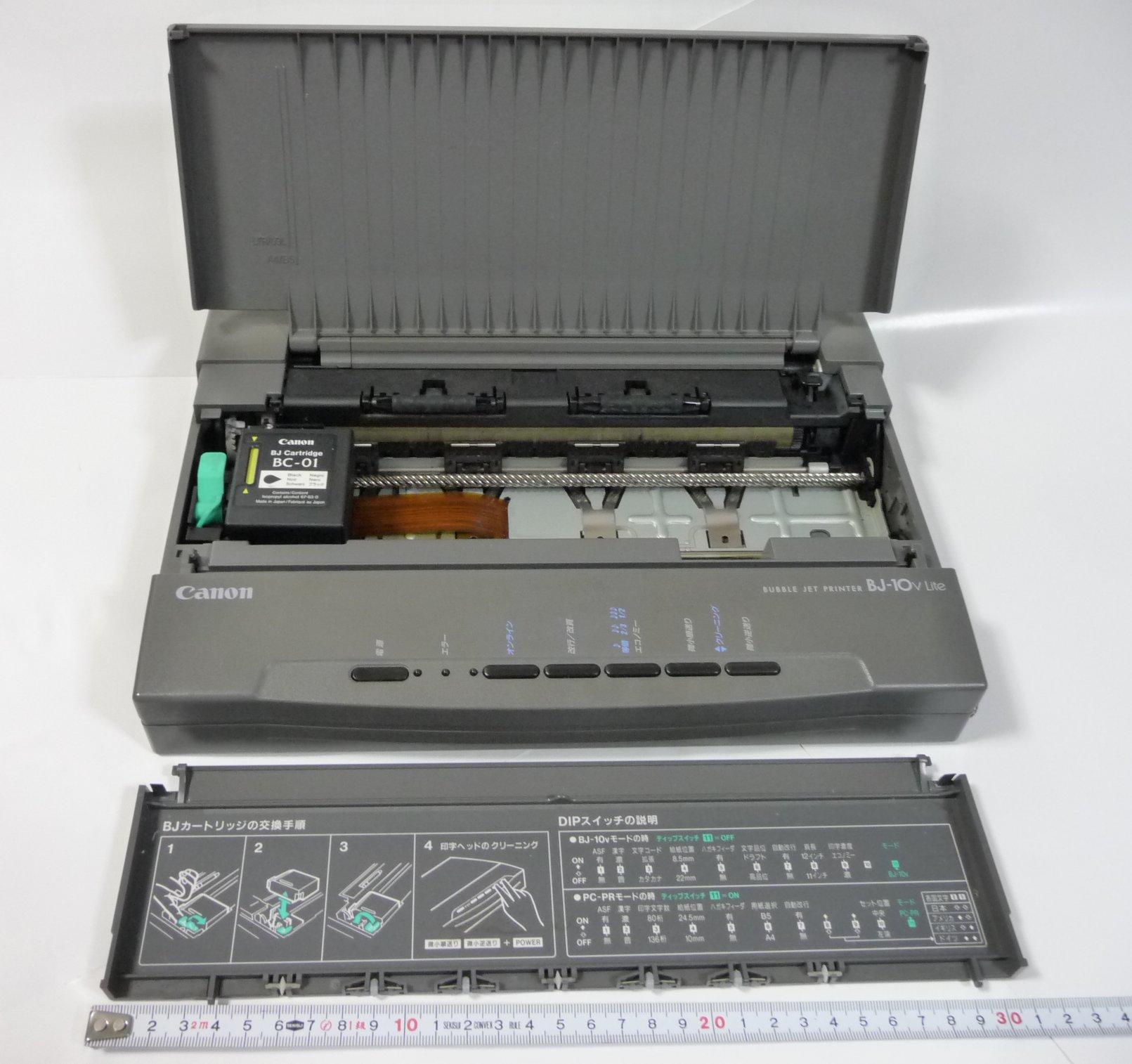
BJ-10v notebook-size Bubble Jet printer introduced.
1992
BJC-820 color Bubble Jet printer introduced (Canon's first full-color inkjet printer).
Around 2000–2001
imageRUNNER digital office multifunction line established (e.g., the imageRUNNER 3300 in 2001).
2004
PIXMA consumer inkjet brand introduced (PIXMA iP-series with the ChromaLife100 dye system).
2006
imagePRESS C1 digital color production system introduced.
2007
imagePRESS C7000VP production press unveiled.
2009
imageRUNNER ADVANCE office MFP platform introduced; Canon announces its offer to acquire Océ (November).
2020
Océ renamed Canon Production Printing (January 1).

Printing technologies
Electrophotography / laser beam printing (LBP). A semiconductor laser scans a charged photoconductive drum to write a latent image, which is developed with toner and fused to paper. Canon's engines have long served as reference implementations of this process, including the widely reused CX engine.
Thermal inkjet ("Bubble Jet"). A thin-film heater in each nozzle chamber vaporizes a small amount of ink, forming a bubble whose expansion ejects a droplet. This is a drop-on-demand method that requires no piezoelectric material. Canon developed this thermal approach and markets it under the Bubble Jet name.
Cartridge and consumable design. Canon developed replaceable all-in-one cartridge concepts in its personal copiers of the early 1980s, an approach echoed in later laser toner cartridge design.
Color laser and digital copying. Canon developed color laser copiers (the CLC series) from the late 1980s, technology that fed into later digital multifunction and production systems.
Major printer families
- LBP (Laser Beam Printer) series — e.g., LBP-10, LBP-8/CX.
- BJ / BJC (Bubble Jet) consumer inkjet series — e.g., BJ-80, BJ-10v, BJC-820.
- PIXMA — consumer and home-office inkjet brand.
- imageCLASS / i-SENSYS — consumer and small-office laser printers and MFPs (regional naming).
- imageRUNNER and imageRUNNER ADVANCE — office digital multifunction (copier/print/scan/fax) systems.
- imagePRESS — digital commercial and production printing presses.
- CLC / NP series — copier lineage (color laser copiers and plain-paper copiers).
- Former Océ lines — now offered under Canon Production Printing.
Product areas
- Consumer / home office: PIXMA inkjet printers and imageCLASS / i-SENSYS laser printers and MFPs.
- Enterprise / office: imageRUNNER and imageRUNNER ADVANCE multifunction devices.
- Industrial / commercial production: imagePRESS digital presses and Canon Production Printing (formerly Océ) systems.
- Fax and copiers: A longstanding plain-paper copier business (NP, CLC series) and fax machines; fax capability is now typically integrated into multifunction devices.
- OEM component supply: Laser print engines supplied to other printer brands.
Major innovations
- Discovery of thermal (bubble-driven) inkjet ejection, the basis of Bubble Jet / thermal inkjet printing, attributed to Ichiro Endo and Canon colleagues with work beginning in 1977. Optica's biography of Endo records that the effect was noticed when a soldering iron accidentally touched a syringe of ink.
- Early commercialization of compact semiconductor laser beam printers, from the LBP-10 to the small and light LBP-8/CX, which Canon described as the world's smallest and lightest laser printer.
- Development of a reusable, standardized desktop laser engine (the CX engine) that enabled multiple vendors' first desktop laser printers.
- Replaceable all-in-one cartridge design in personal copiers, an approach that influenced consumable-cartridge design across the industry.
- Color laser copying (the CLC series) from the late 1980s.
Influence on printing history
Canon's laser engines effectively seeded the desktop laser printing market. By supplying a common, affordable engine to competing brands, Canon enabled the near-simultaneous arrival of the first mass-market desktop laser printers from several vendors in 1984–1985. Combined with page-description languages, those printers helped launch desktop publishing.
In parallel, Canon's thermal Bubble Jet invention established one of the two dominant inkjet architectures — thermal versus piezoelectric — that structured the consumer printing market for decades. Canon's copier and multifunction lineage also contributed to the broader shift from analog copying toward digital, networked office document systems.
Relationships with other manufacturers
Hewlett-Packard. Canon began OEM supply of laser engines to HP in 1984. The first HP LaserJet (1984) used the Canon CX engine, and later HP LaserJet II and III models shared the Canon LBP-CX generation of engines. Separately, Canon and HP independently developed thermal inkjet technology around the same period — Canon's work led by Ichiro Endo, HP's by John Vaught and colleagues — and the two are recognized together as co-originators of the thermal inkjet approach.
Apple. The first Apple LaserWriter (1985) used the same Canon CX engine as the first HP LaserJet; the later LaserWriter II shared the Canon LBP-CX engine generation as well.
Océ. Canon announced its offer to acquire the Dutch production-printing company Océ in November 2009, integrating a major production-printing portfolio that was rebranded Canon Production Printing in 2020.
Legacy technologies
Several Canon product lineages are now historical or have been absorbed into later systems. The BJ and BJC Bubble Jet printers, which pioneered Canon's consumer thermal inkjet output in the 1980s and 1990s, were succeeded by the PIXMA brand. Standalone plain-paper copiers (the NP series) and color laser copiers (the CLC series) gave way to digital imageRUNNER multifunction systems, and dedicated fax machines were largely folded into multifunction devices. The early LBP laser printers and their CX-generation engines, once supplied across the industry, are now of chiefly historical interest, though the electrophotographic principles they embodied remain in current laser products.
Current status
Canon remains an active manufacturer across the printing spectrum: consumer inkjet (PIXMA), consumer and office laser (imageCLASS / i-SENSYS), office multifunction (imageRUNNER and imageRUNNER ADVANCE), and commercial and production printing (imagePRESS and Canon Production Printing, the former Océ business). It continues to develop both its electrophotographic and thermal inkjet technologies.
Frequently asked questions
- Did Canon make the engines for early HP LaserJet printers?
- Yes. Canon began OEM supply of laser engines to Hewlett-Packard in 1984, and the first HP LaserJet (1984) used the Canon CX engine. Later HP LaserJet II and III models shared the Canon LBP-CX engine generation.
- What is Bubble Jet technology?
- Bubble Jet is Canon's name for its thermal inkjet method. A thin-film heater in each nozzle vaporizes a small amount of ink to form a bubble, whose expansion ejects a droplet onto the page. It is a drop-on-demand method that needs no piezoelectric material, and Canon traces its discovery to work by Ichiro Endo and colleagues beginning in 1977.
- Did the first Apple LaserWriter use a Canon engine?
- Yes. The first Apple LaserWriter (1985) used the same Canon CX engine as the first HP LaserJet, and the later LaserWriter II shared the Canon LBP-CX engine generation.
- What happened to Océ?
- Canon announced its offer to acquire the Dutch production-printing company Océ in November 2009. The Océ business was later rebranded Canon Production Printing, effective January 1, 2020.
Source transparency (9 sources)
These references support claims made in this entry. The archive uses verified institutional and public-domain sources only; see Source policy.
Sources consulted (9)
- Canon Inc. — Wikipedia
- HP LaserJet — Wikipedia
- Inkjet printing — Wikipedia
- The History of Canon 1976–1987 — Canon Global
- The History of Canon 1988–1995 — Canon Global
- The History of Canon 1996–2005 — Canon Global
- The History of Canon 2006–2015 — Canon Global
- Laser Printers — CHM Revolution — Computer History Museum
- Ichiro Endo biography — Optica
Continue in the archive
Related reading
Guides · Introductory
How Laser Printers Work
How a laser printer turns a digital page into printed output using static charge, toner, and heat.
Guides · Introductory
How Inkjet Printers Work
How an inkjet printer forms an image by precisely placing tiny droplets of liquid ink onto paper.
Brands · Hewlett-Packard (HP)
Hewlett-Packard (HP): History of Its Printing and Imaging Business
Encyclopedic history of Hewlett-Packard's printing business: ThinkJet, LaserJet, DeskJet, PCL, PageWide, HP Indigo, and the 2015 split into HP Inc.
History · From specialised equipment to mainstream office printing
The Evolution of Laser Printing
How laser printing developed from a specialised technology into a standard for fast, sharp office output.