History
Brother is the printing and document-technology brand of Brother Industries, Ltd., a Japanese manufacturer headquartered in Nagoya, Aichi. Its origins lie in the Yasui Sewing Machine Co., founded in 1908 in Nagoya by Kanekichi Yasui to repair imported sewing machines and make replacement parts. The company's first product, in 1928, was a chain-stitch sewing machine used in straw-hat manufacture, and in 1932 mass production of home sewing machines began — enabled by Jitsuichi Yasui's development of shuttle hooks, with the first domestic model designated the Model 15. The "Brother" name comes from an early sewing-machine model so named in honor of the Yasui brothers.
The business was renamed Nippon Sewing Machine Manufacturing Co. in 1934. In the postwar decades Brother diversified well beyond sewing. It entered the home and studio knitting-machine market in 1954, established Brother International Corporation in the United States — its first overseas sales affiliate — in 1955, and opened a European sales company in Dublin in 1958. The corporate name became Brother Industries, Ltd. in 1962. Through the following decades the company moved into typewriters, office equipment, and consumer electronics.
The 1980s marked Brother's pivot into document technology. It produced the EM-1 electronic office typewriter in 1980, the compact EP-20 electronic personal printer in 1982 (described by Brother as the world's smallest electronic personal printer with a full keyboard), and the first domestically produced Japanese-language personal word processors in 1984. In 1985 Brother Industries (U.K.) Ltd. was established at Wrexham as a typewriter manufacturer. In 1987 the company formally entered the information- and communications-equipment field, launching the FAX-100 and starting production of the HL-8 laser printer. In 1988 it introduced the P-touch label writer for the Japanese market, applying thermal-transfer printing technology.
In the 1990s Brother built out its modern printer lines. It introduced the HL-630 laser printer in 1994, the MFC-4500ML compact laser All-in-One (fax, print, copy, scan) in 1995, and the MFC-7000FC color inkjet All-in-One in 1997. The Brother Group Global Charter was established in 1999. UK typewriter manufacturing at Wrexham continued until November 2012, when the last UK-made typewriter was produced there and subsequently donated to the Science Museum in London.
Timeline
1908
Yasui Sewing Machine Co. founded in Nagoya by Kanekichi Yasui (sewing-machine repair and parts).
1928
First product: a chain-stitch sewing machine (used for straw hats).
1932
Mass production of home sewing machines begins (first domestic model, the Model 15).
1934
Company renamed Nippon Sewing Machine Manufacturing Co.
1954
Enters the home and studio knitting-machine market.
1955
Brother International Corporation established in the United States (first overseas sales affiliate).
1958
European sales company established in Dublin.
1962
Corporate name changed to Brother Industries, Ltd.
1968
Acquires the Jones Sewing Machine Company (UK).
1980
Production of the EM-1 electronic office typewriter begins.
1982
EP-20 electronic personal printer introduced.
1984
First domestically produced Japanese-language personal word processors.
1985
Brother Industries (U.K.) Ltd. established at Wrexham; TC-211 CNC tapping center launched.
1987
Entry into information/communications equipment; FAX-100 launched and HL-8 laser printer production started.
1988
P-touch label writer (thermal transfer) introduced for the Japanese market.
1992
XING Inc. established for online karaoke.
1994
HL-630 laser printer.
1995
MFC-4500ML compact laser All-in-One (fax/print/copy/scan).
1997
MFC-7000FC color inkjet All-in-One.
1999
Brother Group Global Charter established.
2011
Acquires Nefsis (web-conferencing software).
2012
Đồng Nai (Vietnam) sewing-machine factory opened; last UK-made typewriter produced at Wrexham (November).
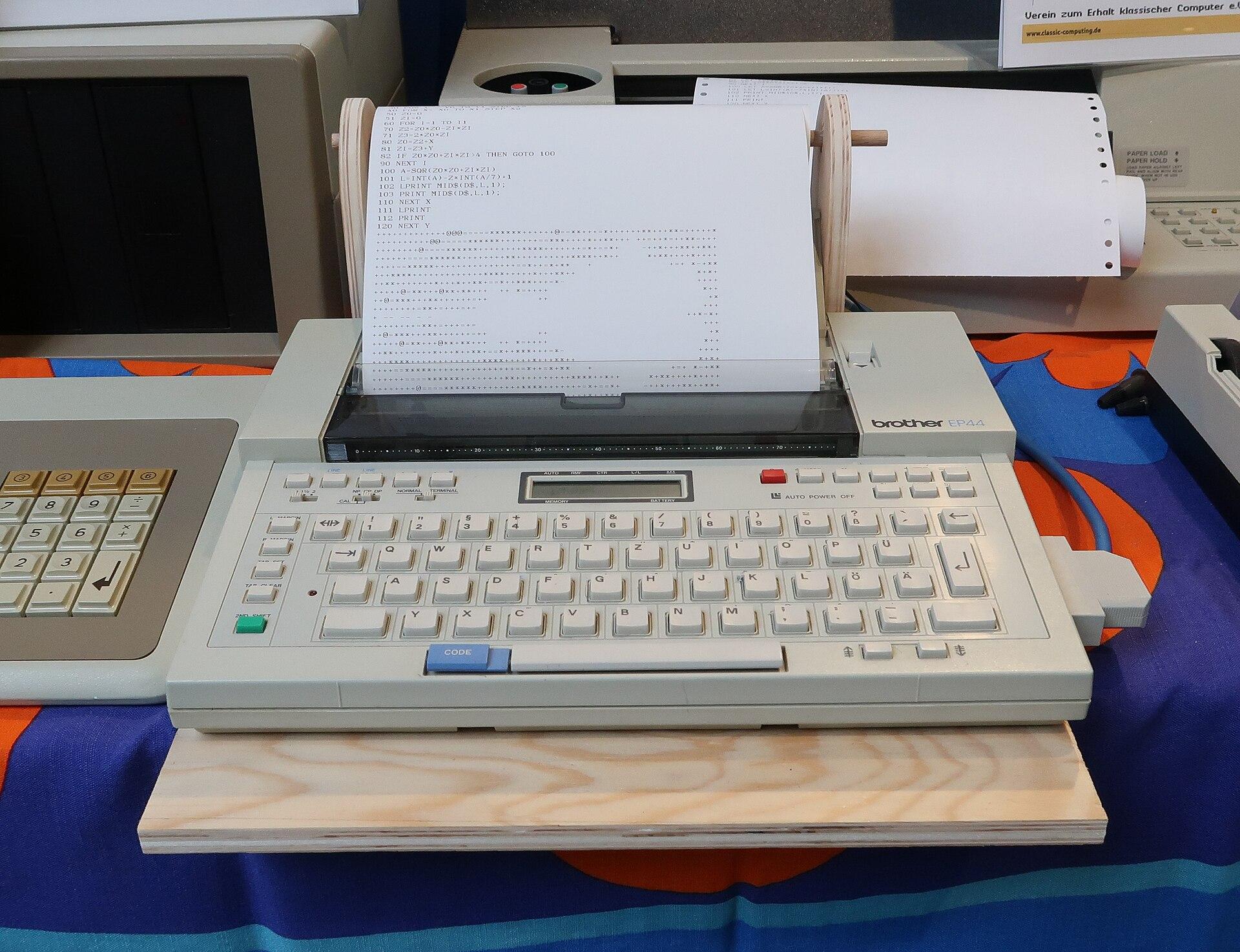
_(24493897618).jpg)
Printing technologies
Across its document-technology history, Brother has drawn on several distinct printing methods:
- Thermal and thermal-transfer printing — used in thermal fax machines and, most enduringly, in the P-touch label line, which applies thermal-transfer printing to desktop labeling.
- Electrophotographic (laser) printing — beginning with the HL-8 (1987) and continuing with the HL-630 (1994), this became the basis of the HL, DCP, and MFC laser families.
- Inkjet printing — used in color All-in-One devices such as the MFC-7000FC (1997) and in later consumer inkjet and ink-tank lines.
The company's earlier heritage in typewriters and electronic personal printers (such as the EM-1 and EP-20) supplied much of the character-conversion and compact-mechanism expertise that carried into its later printer engineering.
Major printer families
Brother organizes much of its printing lineup around a set of named families that distinguish single-function from multifunction devices:
- HL — single-function laser printer series.
- DCP — print/copy/scan multifunction devices without fax.
- MFC ("Multi-Function Center") — print/copy/scan/fax multifunction devices.
- P-touch (PT-) — thermal-transfer label printers and label makers, introduced in 1988.
- FAX- — standalone fax machines (for example, the FAX-100).
The MFC abbreviation for "Multi-Function Center" is consistent with Brother's own usage. The HL and DCP letter expansions circulate widely through reseller and reference sources but are not drawn from a Brother primary document, and are noted here as reported rather than asserted.
Product areas
Although this page focuses on printing, Brother's document-technology output spans several market segments:
- Consumer and home office — home laser and inkjet printers and P-touch label makers, alongside the company's long-running sewing and embroidery machines.
- Small office / SOHO — laser and inkjet MFC and DCP multifunction devices and, historically, standalone fax machines.
- Business and workgroup — higher-volume laser printers and multifunction devices, plus label and mobile printing.
- Fax and communications — a distinct historic category (the FAX- series) that Brother entered in 1987 and continued through the 1990s.
Beyond printing, the same corporation has produced machine tools (such as CNC tapping centers) and industrial sewing and embroidery equipment, reflecting its origins as a manufacturing company rather than a pure office-electronics firm.
Major innovations
Several developments mark Brother's path into document technology:
- Domestic Japanese sewing-machine production at scale from 1932, the foundation of the company's manufacturing expertise.
- Compact electronic personal printing with the EP-20 (1982), which Brother described as the world's smallest electronic personal printer with a full keyboard.
- The P-touch label system (1988), which applied thermal-transfer printing to accessible desktop labeling.
- In-house laser-printer development, with the HL-630 (1994), which Brother has described as the company's first completely in-house-produced product.
- Early color inkjet All-in-One devices with the MFC-7000FC (1997), which Brother presented as a color inkjet All-in-One aimed at the sub-US$1,000 market.
The "world's smallest" and "under US$1,000" descriptions are Brother's own corporate-history claims and are presented here as company statements rather than independently verified facts.
Influence on printing history
Brother is notable for carrying an early twentieth-century sewing-machine and typewriter manufacturer into the digital document era, becoming a durable supplier of laser and inkjet printers and multifunction devices aimed particularly at home and small-office users. Its P-touch line helped popularize accessible thermal-transfer desktop labeling, extending a compact, cartridge-based labeling format to consumers and offices.
The HL/DCP/MFC naming scheme became a widely recognized shorthand for distinguishing single-function laser printers from copy/scan and fax-equipped multifunction devices, a segmentation that mirrored how home and small offices actually purchased printing hardware as multifunction devices displaced separate machines.
Relationships with other manufacturers
Brother's documented corporate transactions largely concern its broader businesses rather than print-engine partnerships:
- Jones Sewing Machine Company (UK) — acquired in 1968, consolidating Brother's UK sewing-machine presence.
- XING Inc. — established in 1992 for online karaoke, a diversification unrelated to printing.
- Nefsis — a web-conferencing software company acquired in 2011.
Beyond these, the authoritative sources reviewed here do not document formal print-engine OEM or technology-sharing partnerships for Brother's printer lines.
Legacy technologies
Two categories once central to Brother have largely wound down. The typewriter business, which reached from electronic office models such as the EM-1 (1980) through decades of UK manufacturing at Wrexham, ended when the last UK-made typewriter was produced there in November 2012 and donated to the Science Museum in London. Standalone fax machines — the FAX- series that Brother launched with the FAX-100 in 1987 — were a distinct product category through the 1990s but have since been largely absorbed into multifunction devices or discontinued. Japanese-language word processors, first produced domestically in 1984, likewise belong to an earlier generation of Brother document technology that has been superseded by general-purpose computing and printing.
Current status
Brother Industries, Ltd. remains an active, publicly listed company (Tokyo Stock Exchange, ticker 6448), headquartered in Nagoya, Japan, with a global sales and manufacturing footprint that includes a large sewing-machine factory in Đồng Nai, Vietnam, opened in 2012. It continues to sell laser and inkjet printers, MFC and DCP multifunction devices, P-touch and industrial label printers, sewing and embroidery machines, and machine tools. The typewriter and standalone-fax categories that were once central to the company have largely wound down, with UK typewriter production ending in 2012.
Frequently asked questions
- When was Brother founded?
- The company traces to the Yasui Sewing Machine Co., founded in 1908 in Nagoya, Japan, by Kanekichi Yasui to repair sewing machines and make parts. It was renamed Nippon Sewing Machine Manufacturing Co. in 1934 and became Brother Industries, Ltd. in 1962.
- Where does the Brother name come from?
- The name comes from an early sewing-machine model named "Brother," itself named in honor of the founding Yasui brothers.
- What do the HL, DCP, and MFC names mean?
- HL denotes single-function laser printers, DCP denotes print/copy/scan multifunction devices without fax, and MFC ("Multi-Function Center") denotes print/copy/scan/fax multifunction devices. The MFC expansion follows Brother's own usage; the HL and DCP expansions are reported by reseller and reference sources rather than a Brother primary document.
- When did Brother start making printers?
- Brother entered information and communications equipment in 1987, launching the FAX-100 and starting production of the HL-8 laser printer. It introduced the HL-630 laser printer in 1994, described as its first completely in-house-produced product.
- What is P-touch?
- P-touch is Brother's line of thermal-transfer label printers and label makers, introduced for the Japanese market in 1988.
- Is Brother still in business?
- Yes. Brother Industries, Ltd. is an active, publicly listed company (Tokyo Stock Exchange, ticker 6448), headquartered in Nagoya, Japan, still producing laser and inkjet printers, MFC/DCP multifunction devices, P-touch label printers, sewing machines, and machine tools.
Source transparency (7 sources)
These references support claims made in this entry. The archive uses verified institutional and public-domain sources only; see Source policy.
Sources consulted (7)
- Brother Industries — Wikipedia
- Brother Group History — 1980s — Brother Industries, Ltd.
- Brother Group History — 1990s — Brother Industries, Ltd.
- Brother Group History — 1950s — Brother Industries, Ltd.
- 100 Years of Innovation / Brother Brand Story — Brother Industries, Ltd.
- Brother History — Foundation to 1940s — Brother Industries, Ltd.
- History Zone | Brother Museum Audio Guide — Brother Industries, Ltd. (corporate museum)
Continue in the archive
Related reading
Guides · Introductory
How Laser Printers Work
How a laser printer turns a digital page into printed output using static charge, toner, and heat.
Guides · Introductory
How Inkjet Printers Work
How an inkjet printer forms an image by precisely placing tiny droplets of liquid ink onto paper.
Brands · Canon
Canon
Encyclopedic history of Canon in printing: laser engines, Bubble Jet thermal inkjet, PIXMA, imageRUNNER, imagePRESS, and its OEM ties to HP and Apple.
Brands · Epson
Epson
Encyclopedic history of Epson, the printing brand of Seiko Epson: the EP-101, MX-80, ESC/P, and Micro Piezo inkjet technology.