History
Epson is the printing and imaging brand of Seiko Epson Corporation, a Japanese electronics manufacturer headquartered in Suwa, Nagano Prefecture, Japan, and a member of the broader Seiko Group. The company's industrial roots lie in precision watchmaking.
The corporate ancestry begins with Daiwa Kogyo, Ltd., founded in May 1942 in Suwa, Nagano, by Hisao Yamazaki, a local clock-shop owner and former employee of K. Hattori, with backing from the Hattori family associated with the Seiko organization. In 1959, a Seiko watch factory in Suwa was combined with Daiwa Kogyo to form Suwa Seikosha Co., Ltd., described as a forerunner of today's Seiko Epson Corporation.
In 1961, Suwa Seikosha established a subsidiary, Shinshu Seiki Co., to make precision components. When the Seiko organization served as official timekeeper for the 1964 Tokyo Summer Olympics, a compact printing timer was needed to record event times. That work led Shinshu Seiki to develop electronic printing mechanisms, culminating in the EP-101 miniature printer, launched in September 1968; the name derives from "EP" for Electronic Printer. The EP-101 is described as one of the first compact digital printers and was incorporated into calculators and other equipment.
The Epson brand name was introduced in 1975 for a new generation of printers descended from the EP-101 — "EP" plus "son," i.e., "son of EP" or "Electronic Printer's Son." Epson America, Inc. was established the same year to sell printers in the United States. Consumer success followed with the MX-80 dot-matrix printer in 1980. In November 1985, Suwa Seikosha and the Epson Corporation merged to form Seiko Epson Corporation.
Timeline
1942
Daiwa Kogyo, Ltd. founded in Suwa, Nagano, an ancestor of the company.
1959
Suwa Seikosha Co., Ltd. formed by combining a Seiko Suwa factory with Daiwa Kogyo.
1961
Shinshu Seiki Co. established as a subsidiary to make precision parts.
1964
Seiko serves as official timekeeper for the Tokyo Summer Olympics, spurring printing-timer development.
1968
EP-101 compact printer launched in September; "EP" stands for Electronic Printer.
1975
The "Epson" brand name is introduced and Epson America is established to sell printers in the U.S.
1980
MX-80 dot-matrix printer introduced in October.
1985
Suwa Seikosha and Epson Corporation merge to form Seiko Epson Corporation in November.
early 1990s
Micro Piezo inkjet technology reaches mass production; the Stylus 800 (MJ-500 in Japan), released in 1993, is the first product with a Micro Piezo printhead.
1994
Epson Stylus Color introduced, an early high-resolution (720 dpi) color inkjet using Micro Piezo.
2015
EcoTank (ET-4550) refillable ink-tank printer debuts in the U.S. market in September.

Printing technologies
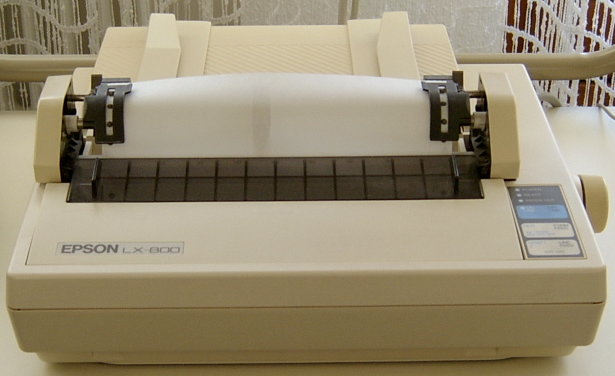
- Impact dot-matrix printing — Epson's early consumer printers, such as the MX-80, formed characters by striking an inked ribbon with a matrix of pins.
- ESC/P (Epson Standard Code for Printers) — an escape-sequence-based control language whose original escape codes trace to early Epson dot-matrix printers and which was later formalized as ESC/P and extended as ESC/P 2. It became a de facto industry standard.
- Micro Piezo inkjet — Epson's piezoelectric drop-on-demand inkjet technology. Rather than heating ink as thermal (bubble) methods do, a stacked piezoelectric actuator — Epson's Multi-layer Actuator Head, or MACH — mechanically ejects ink droplets. Development began around 1990 and reached mass production by the end of 1992.
- Laser/LED page printing — Epson has produced laser-class office printers as part of its later portfolio.
- Ink-tank ("cartridge-free") systems — high-capacity refillable ink reservoirs marketed under the EcoTank brand, aimed at low running cost.
Major printer families
- EP-101 — the pioneering compact digital printer that gave the Epson brand its name.
- MX series — dot-matrix printers, most notably the MX-80.
- FX / LX / LQ series — later dot-matrix lines; the FX and LX families used 9-pin printheads while the LQ ("Letter Quality") family used 24-pin printheads.
- Stylus / Stylus Color / Stylus Photo — inkjet printers built around Micro Piezo technology.
- EcoTank (ET series) — refillable ink-tank consumer and small-office inkjets.
- WorkForce — business-oriented inkjet printers and all-in-ones.
- SureColor (SC series) — large-format and professional/production inkjet printers.
Product areas
Epson's printing portfolio spans several markets, and its parent company operates in adjacent precision fields.
- Consumer / home — inkjet printers and all-in-ones, including the Stylus and EcoTank lines.
- Enterprise / office — business inkjet and laser printers, scanners, and multifunction devices, including the WorkForce range.
- Industrial / professional / production — large-format and signage printers under SureColor, alongside industrial robots and factory-automation products from Seiko Epson.
- Imaging and other — projectors and scanners, and at the parent-company level watches, semiconductors, and quartz timing devices.
Historically, dot-matrix printers also served continuous-form document applications, though Epson is not primarily documented as a standalone fax-machine brand.
Major innovations
- EP-101 (1968) — a landmark in miniaturized digital printing mechanisms.
- MX-80 (1980) — a highly influential consumer dot-matrix printer that helped make desktop printing broadly accessible in the early personal-computer era.
- ESC/P — a printer control language that became an industry reference emulated by competitors.
- Micro Piezo inkjet and the MACH printhead (early 1990s) — a piezoelectric, non-thermal drop-on-demand inkjet approach, first shipped in the Stylus 800.
- High-resolution color inkjet — the Epson Stylus Color (1994) advanced affordable high-resolution color inkjet printing at 720 dpi.
- EcoTank refillable ink-tank printing — a shift away from disposable cartridges toward high-capacity refillable tanks.
Influence on printing history
Epson is widely credited with helping shape desktop printing during the personal-computer era. The MX-80 made reliable dot-matrix printing broadly accessible, and its control language — later formalized as ESC/P — became a common standard that other manufacturers emulated, with many third-party and competitor printers offering "Epson-compatible" emulation modes.
In inkjet printing, Epson's piezoelectric Micro Piezo approach established a durable alternative to thermal inkjet methods and remains closely associated with the brand. The EcoTank ink-tank model contributed to an industry-wide move toward refillable, lower-running-cost consumer printing. Epson's Stylus Color was later recognized by IEEE Spectrum in its "Consumer Electronics Hall of Fame" feature.
Relationships with other manufacturers
Epson began within the Seiko Group as a supplier of watch-parts and precision components, and the Epson brand grew out of that watchmaking heritage through the entities Suwa Seikosha and Shinshu Seiki.
Through the ESC/P control language, Epson's command set became a widely emulated standard, and numerous third-party and competitor printers offered ESC/P ("Epson-compatible") emulation modes, making Epson a reference point for the dot-matrix era. In the early personal-computer market, Epson printers were commonly paired with popular home and business computers of the period, including systems such as the TRS-80.
Beyond these well-documented points, specific OEM or joint-venture partnerships are not detailed here to avoid unverified claims.
Legacy technologies
Several of Epson's most historically significant technologies belong to earlier eras of computing.
- Impact dot-matrix printing — the pin-and-ribbon mechanism of the MX, FX, LX, and LQ families defined desktop output before inkjet and laser printers became dominant, and remained useful for continuous-form and multi-part documents.
- ESC/P and ESC/P 2 — the escape-sequence command language that grew out of Epson's dot-matrix printers persisted as a de facto standard long after the original hardware, supported through emulation by many other manufacturers.
- EP-101 printing mechanism — the compact digital printing mechanism developed from 1960s timekeeping work established the miniaturized-printer lineage from which the Epson name itself descends.
Current status
Epson remains the printing and imaging brand of Seiko Epson Corporation, an active, publicly documented Japanese electronics manufacturer headquartered in Suwa, Nagano. It continues to produce inkjet printers, including successive EcoTank generations, along with business and large-format printers, projectors, scanners, robots, and precision devices, and continues to develop its Micro Piezo inkjet technology.
Frequently asked questions
- What does the name Epson mean?
- The Epson brand name was introduced in 1975 for printers descended from the EP-101. It combines "EP" (Electronic Printer) with "son," giving the sense of "son of EP" or "Electronic Printer's Son."
- What was the EP-101?
- The EP-101 was a compact printer launched in September 1968 by Shinshu Seiki, a Suwa Seikosha subsidiary. Growing out of printing-timer work for the 1964 Tokyo Olympics, it is described as one of the first compact digital printers and gave the later Epson brand its name.
- What is ESC/P?
- ESC/P (Epson Standard Code for Printers) is an escape-sequence-based printer control language whose original codes trace to early Epson dot-matrix printers such as the MX-80. Later formalized and extended as ESC/P 2, it became a de facto industry standard emulated by many other manufacturers.
- How is Epson's Micro Piezo inkjet different from thermal inkjet?
- Micro Piezo is a piezoelectric drop-on-demand technology. Instead of heating ink to form a bubble as thermal methods do, it uses a stacked piezoelectric actuator (Epson's Multi-layer Actuator Head, or MACH) to mechanically eject ink droplets. It first shipped in the Stylus 800 and reached mass production by the end of 1992.
- Is Epson an independent company?
- Epson is the printing and imaging brand of Seiko Epson Corporation, a Japanese electronics manufacturer headquartered in Suwa, Nagano, and part of the broader Seiko Group. Seiko Epson also produces projectors, scanners, robots, semiconductors, and quartz timing devices.
Source transparency (10 sources)
These references support claims made in this entry. The archive uses verified institutional and public-domain sources only; see Source policy.
Sources consulted (10)
- Epson — Wikipedia
- EP-101 — Wikipedia
- Epson MX-80 — Wikipedia
- ESC/P — Wikipedia
- Micro Piezo — Wikipedia
- The Consumer Electronics Hall of Fame: Epson Stylus Color — IEEE Spectrum
- Chapter 5-1: Piezo method at the start of printing innovation (80-Year Journey) — Seiko Epson Corporation
- Micro Piezo Inkjet Technology — Seiko Epson Corporation
- Novel Micro Piezo Technology for Ink Jet Printhead (NIP2007, Okumura) — Society for Imaging Science and Technology
- EPSON ESC/P Reference Manual (1997) — Seiko Epson Corporation
Continue in the archive
Related reading
History · The impact-printing era and its lasting niches
Dot Matrix Printers Explained
What dot matrix printers are, how impact printing works, and why the technology persisted in specific roles.
History · The impact-printing era
How Dot Matrix Printers Work
Dot matrix solved an office problem before it was a mechanism: cheap, durable, simultaneous multi-part copies created in the act of printing.
Guides · Introductory
How Inkjet Printers Work
How an inkjet printer forms an image by precisely placing tiny droplets of liquid ink onto paper.
Guides · Intermediate
What Is PostScript Printing?
An explanation of PostScript as a page description language and why it mattered for predictable, high-quality printing.