Section
Printer & Fax Models
Reference pages on specific printer and fax machine models, built only from sourced, verifiable facts.
56 entries

Reference pages for individual printer and fax machine models. Each page records only what can be verified against an authoritative source — manufacturer spec sheets, museum and archive records, or standards documentation — and omits any figure it cannot cite.
fax models
fax models
Murata Machinery, Ltd. (Muratec / Muratec America)
Muratec Fax Machines
Muratec is the office-equipment brand of Murata Machinery, Ltd., a privately held Kyoto manufacturer that entered the facsimile business in 1972 and introduced the unified MURATEC name in 1991. In North America, Muratec America sold fax machines from 1982 and later broadened into digital multifunctional products that combine printing, copying, scanning, and faxing. This overview describes the Muratec fax line as a family — its ITU-T Group 3 office machines and fax-capable multifunction products — rather than cataloguing the specifications of individual models.
Updated
fax models
Sharp Corporation
Sharp UX Fax Series
The Sharp UX series is a line of standalone Group 3 facsimile machines made by Sharp Corporation, identified by the "UX" model prefix and sold alongside the company's FO-branded fax models. Every UX machine is an ITU-T (formerly CCITT) Group 3 terminal that sends and receives documents over the public switched telephone network, following ITU-T Recommendations T.4 and T.30. The line spans thermal-transfer (film-ribbon) models such as the UX-P200 and later plain-paper inkjet models such as the UX-B700, so this page describes the family at line level rather than cataloguing per-model specifications. Sharp no longer manufactures its standalone UX/FO fax machines for retail, but because they conform to Group 3 the machines remain interoperable with other Group 3 fax devices and services.
Updated
fax models
Panasonic (Matsushita Electric Industrial Co., Ltd.)
Panasonic KX-Fax Series
The Panasonic KX-F series (model numbers beginning KX-F, e.g. KX-FT, KX-FP, KX-FHD, KX-FL and KX-FLB) is a long-running family of Group 3 facsimile machines sold under the Panasonic brand and produced by Kyushu Matsushita Electric Co., Ltd., part of the Matsushita Electric Industrial group. As Group 3 terminals they conform to the ITU-T T.4 and T.30 Recommendations, transmitting over the analog telephone network at the Group 3 scanning densities of 204 x 98 dpi (standard) and 204 x 196 dpi (fine). The line spans direct-thermal (thermal-paper) models, thermal-transfer-film plain-paper models, and later laser plain-paper fax/copiers, with the older thermal and film generation operating at conventional Group 3 speeds and later Super G3 laser models using ITU-T V.34 at up to 33.6 kbit/s. Many units combine the fax with a telephone handset or speakerphone, a digital answering system, a copier and an automatic document feeder.
Updated
fax models
Canon Inc.
Canon FAXPHONE Series
The Canon FAXPHONE series is a line of combined fax-and-telephone machines that Canon marketed for home and small-office use. Bubble Jet (inkjet) models such as the B640 and B740 print received faxes and copies onto plain, cut-sheet paper, while the later FAXPHONE L-series uses a monochrome laser engine. All documented models are Group 3 fax machines that operate over ordinary telephone lines, and the standalone line has since been discontinued in favor of Canon's imageCLASS and PIXMA all-in-one devices.
Updated
fax models
Brother Industries, Ltd.
Brother Fax Machine Series
The Brother Fax Machine Series is Brother Industries' family of Group 3 facsimile machines, sold under FAX-#### model numbers and, in North America, under the IntelliFAX brand for business-class laser models. Over time the line has used several marking technologies — direct-thermal and thermal-transfer on early units, plain-paper inkjet, and plain-paper electrophotographic laser on current models — while conforming to the ITU-T Group 3 standard (page coding per ITU-T T.4, call control per ITU-T T.30). Brother rates its later Super G3 laser models, such as the FAX-2840 and IntelliFax-5750e, at a 33,600 bit/s (V.34) fax modem, while inkjet and other pre-Super-G3 models negotiate up to 14,400 bit/s (V.17) and the earliest thermal units ran slower. This page describes the line at family level: class-level facts are cited to the ITU-T standards and representative specifications to Brother's own documentation, and unsourced or per-model figures are not generalized to the whole series.
Updated
fax models
Model
Desktop vs. Console Fax Machines
Desktop and console fax machines are distinguished by physical form and workload, not by how they send a fax. Both classes are typically ITU-T Group 3 terminals that share the same T.4 image coding, T.30 call procedures, and V-series modulation, so a console unit is not a different kind of fax from a desktop one, only a larger, higher-capacity chassis for heavier duty. Resolution and connection speed are set by the Group 3 standard and the telephone line rather than the cabinet, while paper capacity, memory, footprint, and duty cycle are where the form factors genuinely diverge. Exact per-model figures vary by product and are not asserted for the class here.
Updated
fax models
Model
Roll-Feed vs Cut-Sheet Fax Machines
Roll-feed and cut-sheet describe the two ways a Group 3 fax machine puts a received page on paper. Roll-feed machines print with a direct-thermal head onto heat-sensitive paper drawn from a continuous roll and cut to length, the approach that dominated from the 1970s to the early 1990s. Cut-sheet, or plain-paper, machines instead mark standard Letter or A4 sheets using laser, LED, inkjet, or thermal-transfer engines, and became the office norm from the mid-1990s. Because both classes share the same ITU-T T.4 image coding and T.30 call procedure, the choice affects only the durability and handling of the printout, not what is transmitted.
Updated
fax models
Model
Fax / Copier Combination Machines
Fax / copier combination machines are a class of device that adds local photocopying to a fax terminal by reusing the scanner and printer the fax function already requires: a page is scanned and routed straight to the print engine instead of over the telephone line. Most implement the ITU-T Group 3 standard (Recommendation T.4 for the terminal and image coding, T.30 for call setup), so their fax behaviour, resolutions, and modem speeds follow those specifications rather than any single manufacturer's design. Over time the same integration extended to standalone printing and scanning, producing the multifunction devices that combine copy, scan, print, and fax in one unit. This page describes the class and its shared standards; it does not catalogue individual models or quote pricing.
Updated
fax models
Model
Multifunction Fax Machines (Fax MFPs)
A multifunction fax machine, or fax MFP, is an office all-in-one that folds faxing into a single device alongside printing, scanning, and copying rather than dedicating a machine to fax alone. Its fax function is almost always Group 3, defined by ITU-T Recommendations T.4 (image coding) and T.30 (call setup and transmission over the telephone network), and often Super G3 using V.34 modulation at up to 33.6 kbit/s. Because the fax shares the unit's print engine, output is on plain paper — laser in most enterprise machines and inkjet in home-office models — rather than the thermal roll paper of early standalone fax machines. This page describes the class at family level; it does not list specifications for individual models, and any figure that cannot be traced to an authoritative standard or manufacturer source is omitted.
Updated
fax models
Model
Inkjet Fax Machines
Inkjet fax machines are a class of plain-paper fax devices that print incoming and copied pages with an inkjet engine instead of on the heat-sensitive roll paper used by earlier direct-thermal machines. They were part of the broader move to plain-paper fax that ITU-T-standardized Group 3 machines underwent from the mid-1990s, alongside thermal-transfer and laser models. The printing method is independent of the transmission standard: an inkjet fax still scans, encodes, and sends pages under ITU-T Group 3 (Recommendations T.4 and T.30), typically at about 204 x 98 dpi (standard) or 204 x 196 dpi (fine). This page describes the class at a family level and records only standards- and reference-sourced facts, omitting per-model specifications and pricing.
Updated
fax models
Model
Laser Fax Machines
Laser fax machines are Group 3 facsimile terminals that print incoming documents on plain paper with a laser (electrophotographic) print engine — the same xerographic marking process used by laser printers and photocopiers — rather than onto the heat-sensitive thermal paper used by earlier fax machines. As Group 3 devices they follow the ITU-T T.4 and T.30 Recommendations for image coding and call handling over the public switched telephone network, so they interoperate with thermal and inkjet fax machines regardless of how each one prints. Wikipedia dates the broader shift from thermal-paper to plain-paper fax to the mid-1990s. Many laser fax units were sold as multifunction devices that combined faxing with plain-paper printing, copying and scanning.
Updated
fax models
Model
Plain-Paper Fax Machines
Plain-paper fax machines are facsimile devices that print incoming documents onto ordinary cut-sheet office paper rather than the heat-sensitive coated rolls used by earlier direct-thermal machines. They form the received image with a laser (electrophotographic), LED, inkjet, or thermal-transfer marking engine, producing permanent pages that do not fade or curl. Most are ITU-T Group 3 terminals that send and receive over the ordinary telephone network, so the plain-paper label describes the output method rather than the transmission standard. Encyclopedic histories place the broad transition to plain paper from the mid-1990s, and the class is now typically embodied in multifunction laser and inkjet devices.
Updated
fax models
Model
Thermal-Paper Fax Machines
Thermal-paper fax machines are the roll-fed class of Group 3 fax that print received pages by direct thermal printing, using a thermal printhead to apply heat to a heat-sensitive coated paper roll with no ink, toner, or ribbon. The print method defined the machines: a continuous paper roll, a page cutter, compact desktop bodies, and output that curls and fades over time. They implement the same ITU-T Group 3 standards as other fax machines (T.4 image coding and T.30 call procedures over the telephone network) and differ from plain-paper fax machines only in how the page is put on paper. This reference describes the class at family level and does not assert specifications, prices, or dates for individual models.
Updated
fax models
Model
Super G3 Fax Machines
Super G3 (also called Super Group 3 or SG3) is the high-speed form of Group 3 fax. It is not a separate class of fax defined by the ITU but a Group 3 terminal that carries the image using ITU-T V.34 half-duplex modulation, which supports data signalling rates up to 33.6 kbit/s, rather than the slower modulations used by earlier Group 3 equipment. Because it remains a Group 3 device built on the ITU-T T.4 and T.30 recommendations, a Super G3 machine works over ordinary telephone lines and stays backward compatible with the existing base of standard Group 3 fax machines.
Updated
fax models
Model
Group 4 Fax Machines
Group 4 fax is a class of facsimile apparatus designed for all-digital networks rather than the analog telephone line used by Group 3. It is defined chiefly by ITU-T Recommendation T.6, which specifies the lossless, fully two-dimensional Modified Modified READ (MMR) coding scheme, together with Recommendation T.563 for terminal characteristics. Wikipedia states that Group 4 faxes are designed to operate over 64 kbit/s digital ISDN circuits, and that their resolutions form a superset of the Group 3 (T.4) resolutions. Because it depended on an end-to-end ISDN connection, Group 4 saw limited deployment, and Group 3 remained the standard used on ordinary telephone lines.
Updated
fax models
Model
Group 3 Fax Machines (ITU-T T.4 / T.30)
Group 3 is the class of fax machines defined by ITU-T Recommendation T.4, with call-control procedures in ITU-T Recommendation T.30, for transmitting scanned black-and-white documents over the analog telephone network. Standardized by the CCITT in 1980, it encodes pages at about 204 x 98 dpi (standard) or 204 x 196 dpi (fine) using Modified Huffman and related run-length compression, and sends them through voiceband modems at rates up to 14.4 kbit/s. The faster "Super G3" tier uses V.34-family modulation for rates up to 33.6 kbit/s. Because interoperability is fixed by the ITU-T recommendations rather than by any one vendor, Group 3 became the dominant analog office fax standard and is documented here at the class and standard level rather than as an individual model.
Updated
printer models
printer models
Hewlett-Packard
HP LaserJet 1100
The HP LaserJet 1100 is a monochrome personal laser printer that Hewlett-Packard introduced in 1998. It prints at a rated 8 pages per minute at 600 x 600 dpi with Resolution Enhancement technology (REt), interprets HP PCL 5e, ships with 2 MB of memory (expandable to 18 MB), and connects over an IEEE 1284 parallel port. HP marketed it as "the new, improved personal laser printer standard," and its JetPath-based copier/scanner upgrade produced the all-in-one HP LaserJet 1100A. It uses the single-piece HP UltraPrecise C4092A toner cartridge, rated for about 2,500 pages at 5% coverage.
Updated
printer models
Hewlett-Packard
HP Color LaserJet (Original)
The HP Color LaserJet (product number C3100A) was Hewlett-Packard's first color laser printer, introduced on September 19, 1994 at a list price of US$7,295. Built around a Konica print engine, it produced 300-dpi output using a four-pass CMYK electrophotographic process—about 2 pages per minute in color—and supported HP's PCL 5C color printer language. It printed color on A4/letter-size media and monochrome on larger sheets up to A3/11x17, and was succeeded in 1996 by the Color LaserJet 5 and 5M.
Updated
printer models
Panasonic (Matsushita Electric Industrial Co., Ltd.)
Panasonic KX-P1124
The Panasonic KX-P1124 is an 80-column, 24-pin impact serial dot-matrix printer made by Matsushita Electric Industrial (Panasonic) and documented in Panasonic's Operating Instructions. It printed at up to 192 characters per second in draft and offered five letter-quality fonts, switching between Epson LQ-2500 and IBM Proprinter X24 command sets. It handled continuous fanfold paper on a push/pull tractor and single sheets by friction feed, printing an original plus three copies. IBM later catalogued the same machine as machine type 1515-P51 in an August 1995 technical support reference.
Updated
printer models
Star Micronics
Star Gemini-10X
The Star Gemini-10X is an 80-column, 9-pin serial impact dot-matrix printer documented in Star Micronics' Gemini user's manual and dated by the Computer History Museum to around 1983. It printed at 120 characters per second (at 10 characters per inch) from a user-replaceable 9-wire print head, moving bidirectionally and logic-seeking for text and offering several bit-image graphics densities. The printer connected through a standard Centronics-compatible parallel interface, with an RS-232C serial option, and handled fanfold, roll and single-sheet paper. Its wider-carriage sibling, the Gemini-15X, shared the same manual and mechanism.
Updated
printer models
Oki Data (Oki Electric Industry Co., Ltd.)
Oki OKIPAGE (LED page printers)
OKIPAGE was Oki Data's line of digital LED page printers of the 1990s and early 2000s that formed pages with a fixed LED-array printhead and dry electrophotography rather than the rotating laser and spinning mirror of a conventional laser printer. Representative desktop models such as the OKIPAGE 14 series printed at 14 pages per minute and 600 dpi (up to 600 x 1200 dpi with Oki's smoothing software) and understood PCL, Adobe PostScript, and dot-matrix emulations. The line drew on parent Oki Electric Industry's LED-printer work — the company claims to have made the first LED printer in 1981 — and included the OKIPAGE 8c, described as Oki's first color LED printer, which used a single-pass tandem of four LED/toner stations.
Updated
printer models
Lexmark International, Inc.
Lexmark Optra (1994)
The Lexmark Optra was the flagship laser printer line of Lexmark International, the company created in 1991 from IBM's printer operations. Trade coverage placed its high-resolution models in the mid-1990s: Byte magazine's February 1995 issue evaluated Lexmark's new 1200-dpi Optra printer, one of the products highlighted around Fall Comdex 1994. According to IBM's printer documentation, Optra models rendered pages through enhanced PCL 5 and PostScript Level 2 emulations at 300, 600, or 1200 dots per inch, with options such as duplex printing and broad paper and envelope handling. This page records only specifications traceable to authoritative documentation and omits figures — such as exact print speeds and memory sizes — that could not be verified.
Updated
printer models
Hewlett-Packard
HP 7550A Plotter
The HP 7550A is an eight-pen desktop graphics plotter introduced by Hewlett-Packard in 1984 for engineering drawings, charts, and technical graphics. It held eight pens in a carousel and changed and capped them automatically, drew on media up to ANSI B / ISO A3 size using a grit-wheel paper drive, and accepted drawings written in the HP-GL graphics language. Unlike HP's smaller 7470A and 7475A plotters, it carried both an HP-IB and an RS-232-C interface built in, and it paired a 150-sheet media tray with a single-sheet feeder for unattended plotting. The HP Computer Museum describes it as "the most advanced small plotter ever built" and credits the 7550 product line with a ten-year run spanning the original 7550A and its successor, the HP 7550 Plus.
Updated
printer models
IBM
IBM 1443 (Flying Type Bar Line Printer, 1962)
The IBM 1443 was an impact line printer that IBM introduced in 1962 as a printer for the IBM 1440 Data Processing System, and it was later offered for the IBM 1620, 1710, 1800, and System/360. Unlike the faster chain-and-train IBM 1403, it printed a line at a time by driving hammers against an interchangeable, horizontally scanning "flying type bar" that carried the character set. IBM rated it from about 150 lines per minute with a full alphanumeric set up to roughly 600 lines per minute with a restricted 13-character set, depending on the model and the type bar fitted. Type bars were interchangeable in sets of 13, 39, 52, or 63 characters, and the printer offered 120 or 144 print positions.
Updated
printer models
NEC Corporation (Nippon Electric Company)
NEC Spinwriter
The NEC Spinwriter was a family of letter-quality serial impact printers introduced by NEC in 1977. Instead of a flat daisy wheel, it used a cup-shaped "thimble" print element whose 64 fingers carried up to 128 fully formed characters, struck against a ribbon by a print hammer. Like changing the golf ball on an IBM Selectric, operators could swap thimbles to change typeface or language. Sold through the late 1970s and 1980s across the 3500, 5500, 7700 and other series, it was a common choice for correspondence-grade output before laser and other non-impact printers displaced letter-quality impact machines.
Updated
printer models
Epson (Seiko Epson Corporation)
Epson LQ-1500
The Epson LQ-1500 is an impact dot-matrix printer built around a 24-pin print head, roughly triple the nine pins of Epson's mainstream models, which let it produce near letter-quality text. According to Epson's manuals it printed at 200 characters per second in draft mode and 67 cps in letter-quality mode, formed characters on a 24-by-24 dot matrix, and handled both cut sheets and continuous forms. It connected to host computers through optional plug-in interface cards in parallel, serial (RS-232C) and IEEE-488 versions. Epson has since discontinued the model (product code L502) and lists the LQ-2090II as its replacement.
Updated
printer models
IBM (International Business Machines Corporation)
IBM Proprinter
The IBM Proprinter (model 4201) is a nine-pin impact dot-matrix printer that IBM designed and manufactured as a low-cost printer for the IBM Personal Computer, introduced in 1985. Its official Guide to Operations describes a print head of nine wires capable of up to 200 characters per second, with near-letter-quality, condensed, and dot-addressable graphics modes. The printer's IBM control-code command set (later known as IBM PPDS) became one of the two dominant de-facto standards for PC dot-matrix printing alongside Epson ESC/P, and its screwless, snap-together construction became a widely cited case study in design for automated assembly.
Updated
printer models
Hewlett-Packard
HP DesignJet
The HP DesignJet is a large-format, monochrome thermal inkjet plotter that Hewlett-Packard introduced in 1991 for computer-aided design and engineering drafting. Built around the same print cartridges as HP's DeskJet printers, it printed at 300 dpi on drafting media up to 36 inches wide (E-size / A0 class) and could output a complex D-size drawing in about three minutes. It accepted HP-GL/2 vector and RTL raster data over serial, parallel, and modular I/O interfaces, combining the low running cost of pen plotters with the speed of electrostatic plotters. The original unit, cataloged by the HP Computer Museum as the C1633B, launched the DesignJet line that HP still sells today.
Updated
printer models
Canon Inc.
Canon BJC-4000
The Canon BJC-4000 is a color Bubble Jet (thermal inkjet) printer from Canon's BJC line, built for home and small-office use. It uses interchangeable BC-20 Black and BC-21 Color cartridges — each integrating the print head with ink — to print black text at up to 720 x 360 dpi and color at 360 x 360 dpi, and connects through an 8-bit Centronics-compatible parallel port with Epson LQ and IBM Proprinter emulation. Canon's user manual documents its specifications in detail, though the sources consulted do not record a specific release date.
Updated
printer models
Seiko Epson Corporation
Epson Stylus Color
The Epson Stylus Color, launched in 1994 and sold in Japan as the MJ-700V2C, was a desktop color inkjet printer built on Epson's Micro Piezo piezoelectric drop-on-demand printhead. IEEE Spectrum calls it the world's first high-resolution color inkjet printer, and Epson's corporate history calls it the world's first 720 dpi color inkjet printer. Using a permanent piezo printhead with replaceable ink cartridges and a 16-million-color palette, it set a new photo-quality benchmark and is widely credited with helping establish inkjet as the dominant consumer printing technology.
Updated
printer models
Hewlett-Packard
HP DeskJet 500 (1990)
The HP DeskJet 500 is an inkjet printer that Hewlett-Packard introduced in 1990 under product number C2106A at a US launch price of US$729, according to the HP Computer Museum, which describes it as HP's third-generation 300-dpi inkjet. It kept the same form factor as the earlier DeskJet and DeskJet Plus while adding an enhanced feature set, including two cartridge slots that could load extra fonts or provide Epson FX-80 and IBM Proprinter emulation. Wikipedia records a print speed of about three pages per minute, up from the roughly two pages per minute of the original 1988 DeskJet. It sat in the middle of HP's early DeskJet line, ahead of the colour-capable DeskJet 500C (1991) and 550C (1992).
Updated
printer models
Apple Computer, Inc.
Apple LaserWriter II
The Apple LaserWriter II was a family of 300-dpi monochrome desktop laser printers introduced by Apple Computer, Inc. in 1988, built around a shared Canon LBP-SX marking engine and a modular controller board that could be swapped to change the printer's capabilities. The entry-level LaserWriter IISC was a host-based QuickDraw printer connected by SCSI, while the LaserWriter IINT and IINTX added Adobe PostScript and LocalTalk/AppleTalk networking; the IINTX used a faster Motorola 68020 and could attach a SCSI hard disk for fonts. All three printed at 300 dpi and up to eight pages per minute on the same 45-pound chassis. Apple later extended the line with the PostScript Level 2 LaserWriter IIf and IIg in October 1991, the IIg being described as the first LaserWriter with built-in Ethernet.
Updated
printer models
Hewlett-Packard
HP LaserJet 5 (1996)
Introduced by Hewlett-Packard in 1996, the HP LaserJet 5 (base product number C3916A) was a desktop monochrome laser printer built on a Canon EX-II print engine. HP's own user manual documents true 600-dpi output with Resolution Enhancement technology (REt) and MicroFine toner at 12 pages per minute, driven by the then-new PCL 6 language with built-in HP-GL/2 vector graphics and optional Adobe PostScript Level 2. The base model shipped with 4 MB of memory (expandable to 66 MB) and offered IEEE 1284 parallel, RS-232 serial, and infrared ports plus a Modular I/O slot for HP JetDirect networking; the companion 5M added PostScript and a JetDirect card as standard, and the 5N was the network-ready variant. It succeeded the 600-dpi LaserJet 4 in HP's long-running LaserJet line.
Updated
printer models
Hewlett-Packard
HP LaserJet III (1990)
The HP LaserJet III was a desktop laser printer introduced by Hewlett-Packard in March 1990 at a launch price of US$2,395. Built on a Canon SX print engine, it produced 300-dpi output at eight pages per minute and debuted two headline features: Resolution Enhancement technology (REt), which refined the size and placement of dots for smoother-looking edges, and HP PCL 5, which added scalable Intellifont typefaces and HP-GL/2 vector graphics. It followed the LaserJet II in HP's desktop line and spawned variants including the duplexing LaserJet IIID and the networked LaserJet IIISi.
Updated
printer models
Hewlett-Packard
HP OfficeJet (Original, 1994)
The HP OfficeJet, introduced by Hewlett-Packard in 1994, was a desktop inkjet unit that combined printing, faxing, and copying in a single machine. HP's corporate history describes it as the first all-in-one desktop device to bring those three functions together in one space-saving bundle for home-office users, though earlier office and copier multifunction convergence means this is best read as HP's stated claim rather than an independently verified industry first. As the all-in-one member of HP's inkjet family — the multifunction counterpart to the DeskJet — it helped popularize the consumer and small-office multifunction category. Specifications that cannot be traced to an authoritative source, such as exact resolution, print speed, and price, are omitted here rather than estimated.
Updated
printer models
Hewlett-Packard
HP 7475A Plotter
The HP 7475A is a six-pen desktop pen plotter made by Hewlett-Packard for drafting, charts, and technical graphics. It held six interchangeable pens in a rotating carousel, drew on media up to 11 × 17 inches using HP's grit-wheel paper drive, and accepted drawings written in the HP-GL graphics language. Each unit shipped with either an RS-232-C serial or an HP-IB interface. It was a durable commercial performer that HP continued to sell at a US$1,895 list price even after launching the ColorPro in 1985.
Updated
printer models
Tektronix
Tektronix Phaser (Solid Ink)
The Tektronix Phaser was a family of color printers built around solid ink (phase-change) technology, developed by Tektronix's Color Printing and Imaging Division of Wilsonville, Oregon. Instead of liquid ink or toner, the machines melted solid wax-resin ink sticks and jetted the molten material through piezoelectric printheads. According to the Solid ink history, Tektronix's PhaserJet PXi arrived in June 1991 at a price of nearly US$10,000 — described there as the next color solid ink printer after earlier machines from Howtek and Dataproducts; later models such as the 1995 Phaser 340 improved speed and quality. Tektronix's Color Printing and Imaging Division, including the Phaser brand, was acquired by Xerox in 2000, after which the solid ink line continued under Xerox.
Updated
printer models
Hewlett-Packard
HP LaserJet 4 (1992)
Introduced by Hewlett-Packard in 1992, the HP LaserJet 4 (product number C2001A) is documented by the HP Computer Museum as the company's first 600 dot-per-inch laser printer. Built on Canon's EX print engine, it produced 600 dpi output at eight pages per minute using microfine toner, and supported HP's PCL command language with PostScript available as an option (standard on the companion LaserJet 4M). It launched at US$2,199 and brought TrueType font support to the LaserJet line so that on-screen fonts matched printed output.
Updated
printer models
Canon Inc.
Canon Bubble Jet BJ-80 (Original, 1985)
The Canon BJ-80 was a thermal inkjet printer introduced by Canon Inc. in December 1985. Canon describes it as the world's first inkjet printer to employ its Bubble Jet technology — the heat-driven, drop-on-demand method for which the company filed a basic patent in October 1977. The BJ-80 opened Canon's BJ (Bubble Jet) line, carried through the 1980s and 1990s before the consumer brand later gave way to PIXMA. Authoritative Canon records document its launch and technology; figures such as resolution and print speed are not stated in those sources and are omitted here rather than estimated.
Updated
printer models
Hewlett-Packard
HP DeskJet (Original, 1988)
Introduced by Hewlett-Packard in 1988 as model 2276A, the original HP DeskJet was a thermal-inkjet printer that produced 300 dpi black output on plain paper at about two pages per minute. HP's virtual museum describes it as the company's first mass-market inkjet printer and, at roughly US$1,000 (the HP Computer Museum lists US$995), the least expensive non-impact printer on the market at launch. Its defining feature was a low-cost disposable printhead built into the ink cartridge, which HP credits with keeping print quality consistent over the life of the printer. It was not HP's first inkjet — the 1984 HP ThinkJet held that role — but it established the long-running DeskJet line.
Updated
printer models
Hewlett-Packard
HP ThinkJet (2225, 1984)
The HP 2225 ThinkJet was a thermal inkjet printer introduced by Hewlett-Packard in 1984 at a launch price of US$495. HP's virtual museum documents it as the first mass-marketed personal inkjet printer, and museum records note it was the first HP printer to carry the "Jet" name later used across lines such as LaserJet, DeskJet and OfficeJet. Museum and encyclopedic records list a resolution of 192×96 dpi and a print speed of 150 characters per second, with its quiet operation cited as a key advantage over the dot-matrix printers it competed against. It shipped in several interface variants covering HP-IB, HP-IL, Centronics parallel and serial connections.
Updated
printer models
Apple Computer
Apple ImageWriter (1983)
The Apple ImageWriter, introduced by Apple Computer in 1983, was a nine-pin serial impact dot-matrix printer that Apple based on C. Itoh Electronics' 8510 mechanism with a modified ROM and pinout. It printed dot-addressable bitmap graphics at up to 144 dots per inch and roughly 120 characters per second, and worked across Apple's product line — from the Apple II to the original Macintosh — letting the Mac reproduce on paper the bitmapped image it drew on screen. Carrying the model number A9M0303, it replaced the earlier parallel-interface Apple Dot Matrix Printer and was succeeded by the ImageWriter II in 1985, after which the original became known retrospectively as the ImageWriter I.
Updated
printer models
Star Micronics Co., Ltd.
Star Micronics NL-10
The Star Micronics NL-10 is an 80-column, 9-pin serial impact dot-matrix printer documented in Star's 1985 user's manual. It printed at 120 characters per second in draft Pica and 30 characters per second in near-letter-quality, using bi-directional, logic-seeking movement with both sprocket (tractor) and friction paper feed. Its distinctive feature was a separate plug-in Interface Cartridge that adapted the same base printer to different home and personal computers. Antic magazine's 1987 review singled out its near-letter-quality output as strong for a 9-pin machine at its price.
Updated
printer models
Oki Electric Industry Company, Ltd. (Japan); marketed in the United States by Okidata
Oki Microline (Okidata ML)
Microline (styled Okidata ML in the United States) is the brand name Oki Electric Industry Company gave to its serial impact dot matrix (SIDM) printers, a line that began at the end of the 1970s and ran for decades. Oki records the ML80, which went on sale in 1979 with a 7-pin wire dot head, as the very first Microline model; the line later moved to 9-pin and 24-pin heads across its Old Microline, New Microline, 300, 500 and 300R series, plus an 18-pin colour head in the ML200 series. Marketed in North America by Oki's Okidata sales company, the Microline earned a reputation for reliability — nicknamed "tank-tough" — and stayed widely used for receipts and business documents long after inkjet and laser printers displaced dot-matrix machines for general use.
Updated
printer models
Epson (Seiko Epson Corporation)
Epson FX-80
The Epson FX-80 is a 9-pin impact dot-matrix printer that Epson introduced in 1983 as the successor to its best-selling MX-80. According to Epson's operation manual it printed at 160 characters per second and added a faster printhead, a larger data buffer, user-definable character sets and dot-addressable bit-image graphics. Text jobs printed bidirectionally with logic seeking, and the printer connected through a standard Centronics-style 8-bit parallel interface with optional serial and IEEE-488 connections. It was driven by Epson's escape-code control set, the command lineage the company later codified as ESC/P.
Updated
printer models
Seiko Epson
Epson MX-80 (1980)
The Epson MX-80 is a 9-pin impact dot matrix printer introduced by Seiko Epson in October 1980. It printed at up to 80 characters per second across user-selectable line lengths of 40, 66, 80, or 132 columns, using bidirectional, logic-seeking movement of a nine-pin print head. Seiko Epson's own product history and Wikipedia record it as a landmark commercial success, reporting sales of well over one million units and, by 1982, roughly half the global market for 80-column printers. Wikipedia additionally describes it as the progenitor of Epson's ESC/P control-code language and as the first printer with a disposable, user-serviceable print head.
Updated
printer models
Centronics Data Computer Corporation
Centronics 101
Introduced in 1970 by Centronics Data Computer Corporation of Hudson, New Hampshire, the Model 101 was a character-by-character impact dot matrix printer that formed characters from a 5x7 dot matrix using a seven-solenoid print head at 165 characters per second across a 132-column line. Its 36-pin parallel data interface became an industry de facto standard — a variant of which IBM adopted for the IBM Personal Computer in 1981, later formalized as IEEE 1284. Wikipedia states that Centronics developed the first dot matrix impact printer, though the same article notes the earlier OKI Wiredot (1968) is generally credited as the first such machine; what is well documented is the 101's commercial impact and the wide adoption of its parallel interface. The specifications on this page are drawn chiefly from Centronics' own Series 100 specification document.
Updated
printer models
Teletype Corporation (subsidiary of Western Electric / AT&T)
Teletype Model 33
The Teletype Model 33 is an electromechanical teleprinter introduced by Teletype Corporation in 1963 for light-duty office and data-communications use. It printed at up to ten characters per second (110 baud) using a cylindrical typewheel struck by a hammer, and Wikipedia describes it as one of the first products to adopt the newly standardized seven-bit ASCII code, in an uppercase-only 64-character subset. Sold in ASR, KSR and RO versions — the ASR adding an eight-hole paper-tape reader and punch — it became one of the most widely used computer terminals of the 1960s and 1970s, with over half a million built by 1975 according to Wikipedia. Its maker, Teletype Corporation, was a subsidiary of Western Electric within the AT&T (Bell System) organization.
Updated
printer models
Diablo Systems, Inc. (Diablo Data Systems division of Xerox Corporation)
Diablo 630 (Daisy Wheel Printer)
The Diablo 630 was a daisy-wheel impact printer sold under the Diablo Systems name, the Diablo Data Systems division of Xerox Corporation. It produced letter-quality output comparable to an IBM Selectric at a nominal 30 characters per second using an interchangeable print wheel, and offered Centronics, RS-232, and later GPIB (IEEE-488) interfaces. According to Wikipedia, its control command set became so widely supported that later daisy-wheel and many dot-matrix printers, and even the original Apple LaserWriter, copied or emulated it, making "Diablo emulation" an expected feature. Authoritative sources differ on when it appeared: the Computer History Museum's history dates the Model 630 to 1976, while Wikipedia dates its sale to 1980.
Updated
printer models
IBM
IBM 1403 (Line Printer, 1959)
The IBM 1403 was a high-speed impact line printer that IBM introduced in 1959 as part of the IBM 1401 Data Processing System. It printed a full line at a time by firing individual hammers against a fast-moving print chain that carried five copies of a 48-character set, and the original model produced about 600 lines of text per minute. Later variants, including the Model 3, raised throughput to roughly 1,100 lines per minute and replaced the chain with a print train. Columbia University's computing history records that the 1403 remained unsurpassed for print quality until the advent of laser printing in the 1970s.
Updated
printer models
Xerox
Xerox DocuTech (Production Publisher, 1990)
The Xerox DocuTech Production Publisher, announced on October 2, 1990, was a high-speed digital printing system that scanned, stored, edited, and printed documents at 600 dpi and up to 135 letter-size pages per minute. It coupled a xerographic print engine with a digitally driven, dual-beam Laser ROS (Raster Output Scanner) so that electronic page images could be turned into print-shop-quality, bound documents on demand. Xerox credits the DocuTech line with establishing the modern digital print-on-demand industry, a contribution recognized by a 2005 U.S. National Medal of Technology and Innovation. Later variants added networking (the DocuTech 135 Network Publisher in 1992) before the platform gave way to the DocuTech 61xx series and, eventually, Xerox Nuvera systems.
Updated
printer models
Xerox Corporation
Xerox 9700
The Xerox 9700 Electronic Printing System, introduced in 1977, was a high-volume laser printer that produced 300-dpi output on cut-sheet plain paper at up to 120 pages per minute. Built on the Xerox 9200 copier platform and driven by a modified DEC PDP-11/34 controller, it applied laser xerography developed at Xerox PARC by Gary Starkweather's team. Xerox describes it as its first commercial laser printer and one of the most successful products in its history, and it became a mainstay for high-volume billing and statement printing.
Updated
printer models
IBM
IBM 3800
The IBM 3800 Printing Subsystem was a high-speed laser printer that IBM announced in 1975 and first shipped in 1976 as a channel-attached peripheral for System/370 mainframes. It used a low-powered laser and an electrophotographic process to print on continuous fanfold paper at roughly 167 impressions per minute. It is widely credited as the first commercially available laser printer. Successive models raised resolution and adjusted speed before the line was superseded by the IBM 3900 and discontinued in 1999.
Updated
printer models
Canon
Canon LBP-CX Print Engine (1983)
The Canon LBP-CX was a desktop laser-printer engine that Canon introduced in 1983, built around a semiconductor laser diode and rated at 300 dpi. Its defining consumable was an all-in-one cartridge combining the toner with the photoconductor drum plus the charging and cleaning systems. The engine is best known as the shared mechanism inside two landmark 1980s printers, Hewlett-Packard's HP LaserJet (1984) and Apple's LaserWriter (1985), which is why early units of both used interchangeable toner cartridges and paper trays. Canon later moved the desktop line to the LBP-SX engine.
Updated
printer models
Apple Computer, Inc.
Apple LaserWriter (1985)
The Apple LaserWriter was a 300-dpi laser printer announced by Apple Computer, Inc. on January 23, 1985 and shipped that March at a retail price of US$6,995. It combined a Canon CX print engine with a built-in Adobe PostScript interpreter and connected to Macintosh computers over Apple's LocalTalk network, letting several machines share a single printer. Together with WYSIWYG software such as Aldus PageMaker, it became a cornerstone of the desktop publishing revolution. The original model is documented as discontinued on February 1, 1988, after the LaserWriter Plus had extended the line.
Updated
printer models
Hewlett-Packard
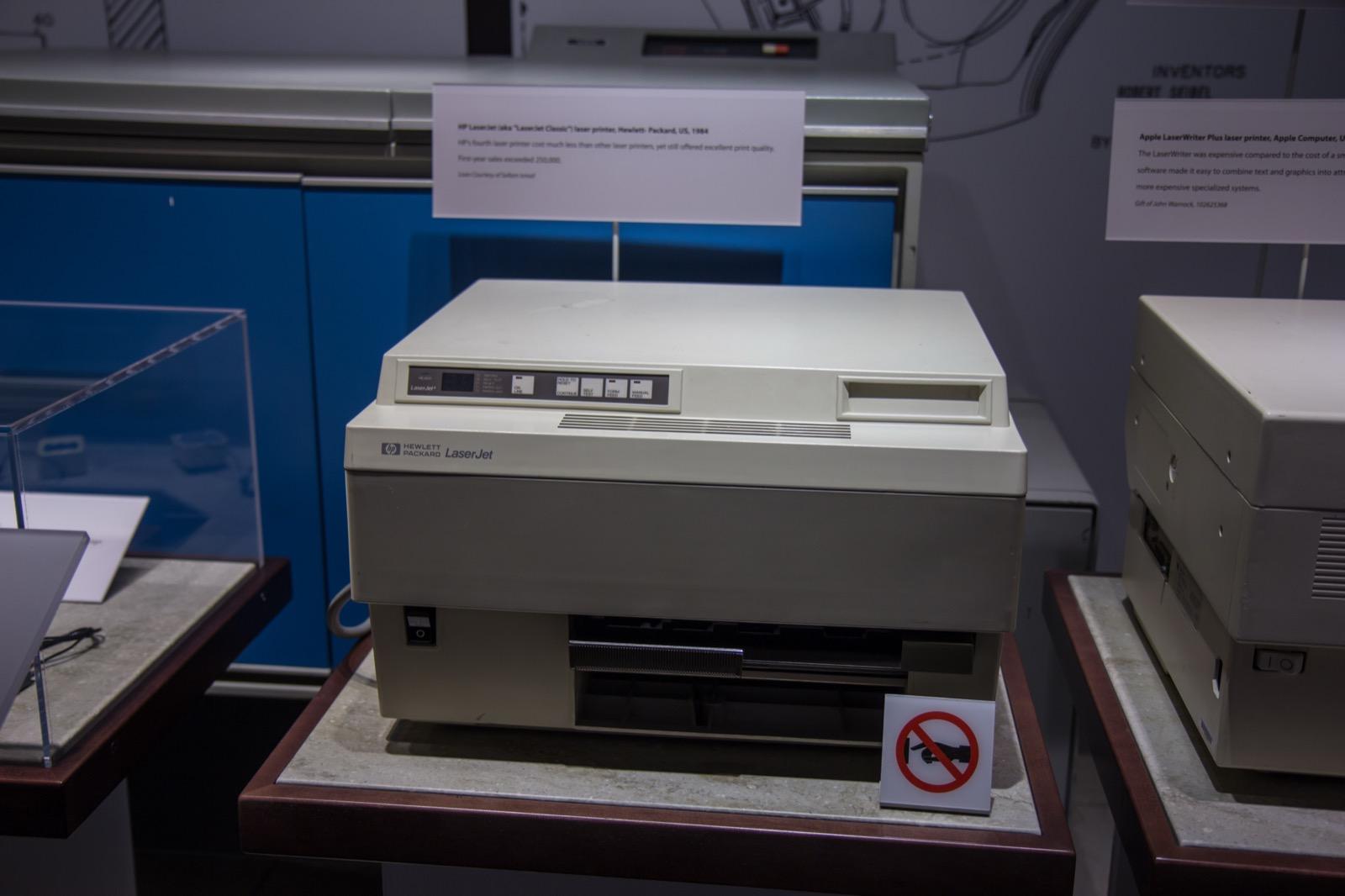
HP LaserJet (Original, 1984)
Introduced by Hewlett-Packard in 1984, the original HP LaserJet (model 2686A) is widely documented as the world's first desktop laser printer. It paired a Canon CX print engine with an all-in-one toner cartridge to produce 300 dpi output at eight pages per minute, driven by the PCL command language over a serial RS-232-C interface. Launched at US$3,495, it established HP's LaserJet line and helped open the desktop laser printing market.
Updated