
Key takeaways
- The primary source is "The Office of the Future", Business Week no. 2387, 30 June 1975, pp. 48-70. PrinterArchive has not obtained a copy, so this page describes the forecast rather than quoting it.
- "Paperless office" is very probably not the article's own phrase. Xerox PARC's institutional language was "the Office of the Future", and a US trademark filing claims commercial use of THE PAPERLESS OFFICE from June 1978.
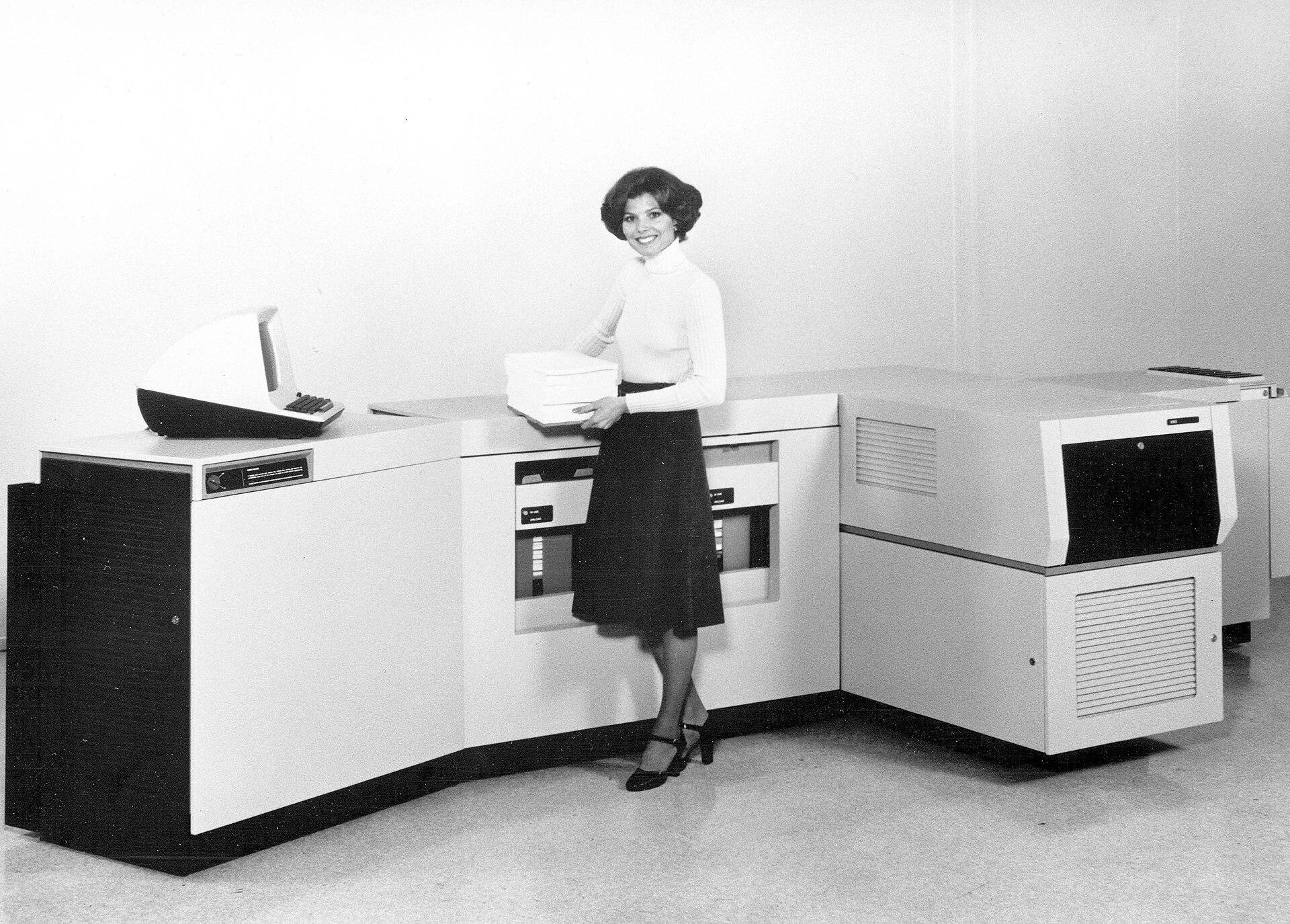
- Xerox PARC — founded in 1970 with the stated goal of developing the office of the future — is also where Gary Starkweather's laser-printing work led to the Xerox 9700, a machine the Computer History Museum describes as printing 120 pages per minute.
- US generation of paper and paperboard — the Environmental Protection Agency's municipal-waste measure, not a measure of office output — stood at 87.7 million tons in 2000, the high end of the EPA's published comparison and twenty-five years after the forecast.
- It then fell to 67.4 million tons by 2018, with the EPA attributing part of the office-grade decline to electronic transmission of reports. The honest verdict is neither triumphalist nor dismissive.
- The bookend is bureaucratic rather than technological: a US federal paperless deadline set for 31 December 2022 was pushed back to 30 June 2024.
The article everybody cites and almost nobody has read
The bibliographic details are stable across independent citations: "The Office of the Future", Business Week, issue 2387, 30 June 1975, pages 48 to 70. The piece exists. What does not exist, in any form this archive could reach, is a copy of it. There is no free full text online; the most-linked reproduction has been unreachable behind an expired certificate; and the sentences circulating as "the quote" have been passed hand to hand for decades without anyone visibly returning to the page.
That would be a footnote if the retellings were disinterested. They are not. A striking share of the quotations in circulation appear on the blogs of companies selling document-management software — parties with a direct commercial interest in the 1975 forecast sounding as naive as possible, because the naivety is the setup for the sales pitch. The prediction has been sanded down over fifty years into a punchline, and the sanding was done mostly by people who profit from the punchline. That is reason enough to treat every confident sentence about what Business Week said in 1975 as unverified until someone pulls the bound volume.
The phrase probably came later, and from the trade show
The Computer History Museum records that Xerox established its Palo Alto Research Center in 1970 under the direction of George Pake, and that the centre's stated goal was to develop "the Office of the Future". The phrase in the Business Week headline is therefore most likely PARC's own institutional language, picked up by a journalist, rather than a coinage. Treating "paperless office" as a 1975 invention — of the magazine, of Pake, of anyone — is the standard error in this story.
There are two better-documented claimants for the term itself. The librarian and information scientist F. Wilfrid Lancaster published Toward Paperless Information Systems with Academic Press in 1978: a serious book-length statement of the thesis, which is a different kind of artefact from a magazine interview. And more decisively, a US trademark application for the mark THE PAPERLESS OFFICE, serial number 73420203, was filed on 4 April 1983 and abandoned on 23 July 1984 for failure to respond. Its goods and services were the promotion of automated office equipment through a demonstration centre and seminars. Critically, the filing claims first use anywhere in May 1978 and first use in commerce in June 1978.
That last detail reorders the whole story. If the trademark's first-use dates are accurate — and they are the applicant's own uncorroborated declaration, made in 1983 — then by the middle of 1978, three years after the Business Week piece, "the paperless office" was already something a company put on a booth and ran seminars about. On that reading it was not a prophecy that escaped from a magazine and slowly infected the industry. It was a sales category almost from the start, and it has stayed one. The trademark lapsed; the pitch did not.
Pake hedged; the retellings added the confidence
George Pake was not a futurist by trade. The National Academy of Sciences records him as a magnetic-resonance physicist and research administrator — provost at Washington University through the 1960s before Xerox recruited him to build PARC. The passage most often attributed to him from 1975 describes calling documents up from his files on a screen, retrieving mail and messages at the press of a button, and then closes on an explicit admission that he did not know how much hard copy he would still want in such a world.
Read as reported, that is not a confident forecast of paper's death. It is a description of a workstation followed by a shrug about paper. An argument that "a specific, dated, confident prediction failed" cannot honestly be built on a passage that is none of those three things. What failed was not really Pake's sentence. What failed was the version of it that circulated afterwards, with the hedge trimmed off and a date attached.
The attribution problem runs deeper. Pake was one interviewee among several; Vincent E. Giuliano, then of Arthur D. Little, is quoted from the same feature just as often, usually to the effect that most record-handling would be electronic by 1990. Which man said which sentence — and whether either was quoted directly or paraphrased in the magazine's own editorial voice — cannot be settled without the page. The floating dates make this worse: some retellings have paper all but gone by 1995, others have electronic record-handling dominant by 1990, and these look like a conflation of the article's scenario framing with a separate projection. Where an attributable statement of the office-automation thesis is needed, Giuliano's own signed article in Scientific American 247(3), September 1982, pages 148 to 164, is a far better citation than any second-hand account of what he said in 1975.
The office of the future shipped a paper machine
Here is the part of the story the vendor retellings leave out. The laboratory whose stated mission was the office of the future is also where the laser printer was developed. The Computer History Museum dates Gary Starkweather's realisation that a laser could write an image directly onto a copier drum to 1967, records his transfer to PARC in 1971, and says he had a working laser printer within about a year; the Dover prototype led to the Xerox 9700, which the museum describes as printing 120 pages per minute on standard paper.
The dates here are genuinely contested and worth handling carefully rather than flattening. Starkweather's insight is placed in 1967 by the Computer History Museum and in 1969 by other accounts. The IEEE's Milestone dedication frames the commercial laser printer's development as spanning 1971 to 1977, which is the most defensible window to cite. The 9700 itself is variously described as manufactured from 1977 and as reaching the market in 1978. The bare word "first" does more harm than good in this paragraph. Elsewhere the archive's Xerox 9700 page gives the 1969 Webster, New York date and repeats Xerox's own description of that machine as its first commercial laser printer; the second is flagged there as a company claim, the first is not, and this page follows the institutional dating above rather than either.
| Event or artefact | What the source says | Source |
|---|---|---|
| Xerox PARC established | Founded 1970 under director George Pake; stated goal to develop "the Office of the Future" | Computer History Museum |
| Laser-on-drum insight | Dated 1967 by the museum; other accounts give 1969. Treat as contested. | Computer History Museum |
| Starkweather at PARC | Transferred 1971; a working laser printer built within roughly a year | Computer History Museum |
| Commercial laser printer development | Framed as a 1971-1977 window rather than a single date | IEEE Milestone dedication |
| Xerox 9700 | Printed 120 pages per minute on standard paper; described as manufactured from 1977, marketed from 1978 depending on the account | Computer History Museum |
| Xerox Alto | Recognised by IEEE for establishing personal networked computing across 1972-1983 | IEEE Milestone dedication |
Sources: Computer History Museum, Revolution: Input & Output galleries; IEEE Engineering and Technology History Wiki, Milestones
There is an anecdote that belongs here, correctly labelled. Writing in IEEE Spectrum, David C. Brock — director of curatorial affairs and of the Software History Center at the Computer History Museum — relays the recollection that PARC generated more paper than anywhere else, because anyone with an Alto and a laser printer could push a button and produce thirty copies of a report. That is a participant memory, not a measurement of PARC's paper consumption, and it should not be cited as a statistic. As an illustration of the mechanism, though, it is exact: the office of the future did not fail to arrive. It arrived, and it came with a printer attached.
Twenty-five years of the opposite
This page has not obtained a US office-paper series for the years between the forecast and the turn of the century, so it will not put a shape on that curve. What can be said is that the document technologies which arrived in those decades were the same family the forecast celebrated, and that every one of them ended in a sheet of paper. Cheap laser and inkjet output put a printer on the desk. Desktop publishing turned the page from a stream of characters into a designed object that people wanted physical copies of. The photocopier made duplication free at the point of use. And the fax machine — a device whose entire purpose is to convert paper into paper at a distance — was still a growth market decades after paper was pronounced dead.
Jonathan Coopersmith's history of facsimile is the source usually behind the figures here: standalone fax machine sales peaked in the United States in 1997 at roughly 3.6 million units, and in Japan around 2000. Two qualifications matter. Those are sales of standalone machines, which is not the same measure as transmission volume; and fax traffic persisted for decades afterwards in healthcare and legal work, so "fax died" is simply false. The usable point is narrower and stronger: a paper-output technology was still expanding its installed base more than twenty years after the office was supposed to have stopped needing paper.
The explanation the 1975 forecast lacked arrived in 2001, in Abigail Sellen and Richard Harper's The Myth of the Paperless Office (MIT Press). Their argument, built from ethnographic and cognitive-psychology fieldwork, is that paper persisted not out of institutional inertia or generational habit but because of its affordances — the specific things a sheet of paper lets a person do that a screen of that era did not, including spatial arrangement across a desk, rapid cross-referencing between documents, and annotation while reading. Paper was not the residue of an unfinished transition. It was a working tool being chosen on the merits.

Then it started coming true, for reasons nobody predicted
The smug version of this story — the paperless office never happened, isn't that amusing — is now itself out of date, and the data that retires it is public. Environmental Protection Agency figures for paper and paperboard entering the US municipal solid-waste stream — a measure of what is discarded, not of what is produced, bought or printed in offices — show generation of paper and paperboard products declining from 87.7 million tons in 2000 to 67.4 million tons in 2018. The EPA also states, in its own words, that "the generation of office-type (high grade) papers also has been in decline, due at least partially to activities such as the increased use of the electronic transmission of reports."
The pattern is not confined to the United States. Michael Briscoe's 2022 reassessment in Sustainability: Science, Practice and Policy, working from the Food and Agriculture Organization's long-run forest-products series, finds global paper consumption levelling out and declining across most regions, in some cases sharply. The peer-reviewed answer to the question in that paper's title — still a myth? — is no longer a simple yes.
What the aggregate series cannot tell you is which causes did the work. Office paper, newsprint, printing and writing grades and packaging all move for different reasons, and a decline driven by the collapse of print advertising is a different phenomenon from a decline driven by document workflow. The EPA's own attribution is careful and partial — "due at least partially" — and this page will not be less careful than its source. What can be said is that the mechanism named in 1975, a manager calling documents up on a screen at his own desk, was at best a fraction of it. The screen arrived on schedule and offices went on consuming paper for another quarter century. What finally moved the curve came later and looked different: ubiquitous networks, attachments, mobile screens good enough to read on, and the gradual loss of paper's role as a transmission medium rather than as a reading surface.
30 June 1975
Business Week issue 2387 carries "The Office of the Future" across pages 48-70. PrinterArchive has not inspected a copy; all descriptions here are second-hand and flagged as such.
1971-1977
The IEEE Milestone window for development of the commercial laser printer, the work that produced the Xerox 9700 out of the same laboratory as the office-of-the-future programme.
1978
F. W. Lancaster publishes Toward Paperless Information Systems (Academic Press). A later trademark filing claims first commercial use of THE PAPERLESS OFFICE in June of the same year.
September 1982
Vincent Giuliano sets out the office-automation thesis under his own name in Scientific American 247(3), pp. 148-164 — the citable version of what he is usually paraphrased as having said in 1975.
1983-1984
US trademark application 73420203 for THE PAPERLESS OFFICE is filed on 4 April 1983 and abandoned on 23 July 1984 for failure to respond.
1997
Standalone fax machine sales peak in the United States at roughly 3.6 million units (Coopersmith); the Japanese peak follows around 2000.
2000
US generation of paper and paperboard products is 87.7 million tons (EPA), the start of the published EPA comparison — twenty-five years after the forecast.
2001
Sellen and Harper publish The Myth of the Paperless Office, supplying the affordances-based explanation the forecast never had.
2018
US paper and paperboard generation is down to 67.4 million tons, with the EPA crediting electronic transmission of reports for part of the office-grade decline.
28 June 2019
OMB and NARA issue Memorandum M-19-21, setting 31 December 2022 as the date NARA will stop accepting paper records.
23 December 2022
M-23-07 extends the deadlines to 30 June 2024, citing implementation delays.
The bookend is a memo, not a machine
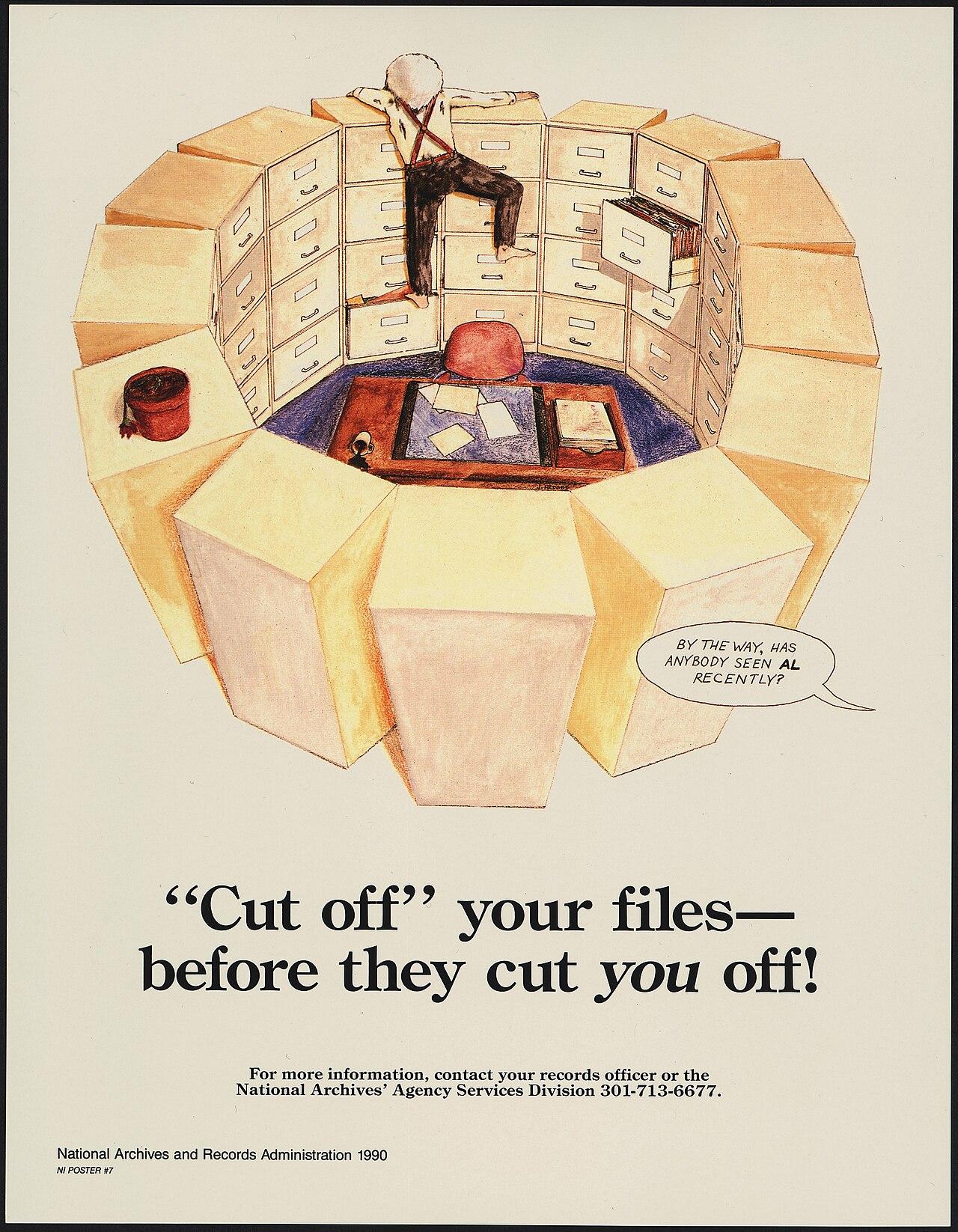
The clearest closing date in this story is not a product launch. On 28 June 2019, the Office of Management and Budget and the National Archives and Records Administration jointly issued Memorandum M-19-21, "Transition to Electronic Records", signed by Russell T. Vought as Acting Director of OMB and David S. Ferriero as Archivist of the United States. It directs federal agencies to ensure that all federal records are created, retained and managed in electronic formats with appropriate metadata, to close agency-operated analog storage facilities, and it states that NARA will end acceptance of paper records by 31 December 2022. The memo's own text reaches for the word: electronic — or "paperless" — government.
Forty-four years after a magazine feature described a manager reading his mail off a screen, the United States government set itself a literal deadline for the end of paper. And then, on 23 December 2022 — eight days before it fell due — OMB and NARA issued M-23-07, moving the deadlines to 30 June 2024 and citing pandemic-related implementation delays, with exceptions available to individual agencies. Even the deadline was late.
How to read the forecast now
The received story is that a magazine predicted the death of paper and was laughably wrong. Almost every element of that sentence is unreliable. The magazine's headline was about the office of the future, not a paperless one. The phrase people mock was claimed as a trade-show marketing term from 1978 and may never have appeared in the article at all. The interviewee most often quoted is reported to have closed by saying he did not know how much hard copy he would still want. And the prediction, judged on the numbers rather than the punchline, was not wrong so much as roughly twenty-five years early — and then partly vindicated by causes its authors never named.
What makes the episode worth revisiting is the mechanism, not the miss. The same company, the same decade, and in the laser printer's case the same research programme produced both the vision of the screen-based office and the prototype behind the machine that put 120 pages a minute into data centres. Each new capability for handling documents electronically also lowered the cost of putting one on paper, and for twenty-five years the second effect ran ahead of the first. That is not a failure of foresight about technology. It is a failure of foresight about what people do when a technology gets cheap.
What remains of office paper in the 2020s is mostly a round trip rather than a stock: a document exists electronically, is printed because a signature, an inspection or a regulator requires a physical page, and is scanned straight back into the system it came from. The archive covers the machinery of that cycle across its scanning and records-management pages. Whether that residue eventually disappears is, on the evidence assembled here, a question about institutions and law rather than about hardware — which is exactly the kind of question a 1975 forecast about workstations was never equipped to answer.
Frequently asked questions
- Did Business Week actually predict the paperless office in 1975?
- It published a feature titled "The Office of the Future" in issue 2387, dated 30 June 1975, pages 48 to 70. That much is consistently cited. Whether the article used the phrase "paperless office", and which of its interviewees made which claim, cannot be confirmed without inspecting a copy — and no free full text is available. This archive describes the forecast rather than quoting it.
- Who coined the term "paperless office"?
- There is no settled answer, and the 1975 attribution is the weakest of the candidates. Xerox PARC's own language, per the Computer History Museum, was "the Office of the Future". F. W. Lancaster published Toward Paperless Information Systems in 1978, and US trademark application 73420203 for THE PAPERLESS OFFICE claims first commercial use in June 1978 — evidence that it was already a marketing term by then.
- Did office paper use really go up after the prediction?
- The EPA's own office-grade statement is the relevant one: it reports that generation of office-type (high grade) papers has been in decline, due at least partially to increased electronic transmission of reports. The all-grades series often quoted here — a municipal-waste measure, not an office measure — stood at 87.7 million tons in 2000 and 67.4 million tons in 2018. This archive has not obtained a verified US office-paper series for the years between 1975 and 2000, so it does not assert what that curve did.
- Is the paperless office still a myth?
- Less so than it was. Michael Briscoe's 2022 reassessment in Sustainability: Science, Practice and Policy, using FAO data, finds global paper consumption levelling out and declining across most regions. The accurate summary is that the forecast was roughly a quarter-century early and then came partly true — not that it never happened, and not that it was fulfilled as predicted.
- When did the US government go paperless?
- It has not, on the original schedule. OMB and NARA's M-19-21 (28 June 2019) set 31 December 2022 as the date NARA would stop accepting paper records. M-23-07, issued 23 December 2022, extended the deadlines to 30 June 2024, with exceptions available to individual agencies.
Source transparency (14 sources)
These references support claims made in this entry. The archive uses verified institutional and public-domain sources only; see Source policy.
Sources consulted (14)
- Memorandum M-19-21, "Transition to Electronic Records" (28 June 2019) — Office of Management and Budget / National Archives and Records Administration
- "OMB M-23-07 Released" (27 December 2022) — National Archives and Records Administration, Records Express blog
- National Overview: Facts and Figures on Materials, Wastes and Recycling — US Environmental Protection Agency
- Xerox PARC (Revolution: Input & Output gallery) — Computer History Museum
- Laser Printers (Revolution: Input & Output gallery) — Computer History Museum
- Milestones: Development of the Commercial Laser Printer, 1971-1977 — IEEE Engineering and Technology History Wiki
- George E. Pake — member directory entry and Biographical Memoir — National Academy of Sciences
- US trademark "THE PAPERLESS OFFICE", serial no. 73420203 — United States Patent and Trademark Office (record via the Justia Trademarks mirror)
- The paperless office twenty years later: Still a myth? — Michael D. Briscoe, Sustainability: Science, Practice and Policy 18(1): 837-845 (2022)
- The Myth of the Paperless Office — Abigail J. Sellen and Richard H. R. Harper, MIT Press (2001; paperback 2003)
- Toward Paperless Information Systems — F. Wilfrid Lancaster, Academic Press, New York, 1978
- The Mechanization of Office Work (ERIC record EJ267490) — Vincent E. Giuliano, Scientific American 247(3), September 1982, pp. 148-164
- Faxed: The Rise and Fall of the Fax Machine — Jonathan Coopersmith, Johns Hopkins University Press, 2015
- 50 Years Later, We're Still Living in the Xerox Alto's World — David C. Brock, IEEE Spectrum (March 2023)
Continue in the archive
Related reading
History · The managed-document enterprise
Enterprise Document Management
How organisations moved from filing cabinets to managing documents as governed records: captured, indexed, retrieved, retained, and disposed of by rule.
History · From specialised equipment to mainstream office printing
The Evolution of Laser Printing
How laser printing developed from a specialised technology into a standard for fast, sharp office output.
History · The shared-office era
The Evolution of Office Printing
How printing in the office became shared infrastructure — a contended, managed resource rather than a personal device on a desk.
History · The centralised print room
Office Print Rooms
Before printing reached every desk, output lived in a staffed print room: a department, a cost centre, and a chokepoint that desktop printing later dismantled.