Key takeaways
- The print room was an organisational form — centralised reproduction — not merely a location with machines in it.
- Centralisation followed from the cost, skill, and volume that early reproduction equipment demanded; pooling those was cheaper than duplicating them.
- Cheap desktop devices removed the economic case for the room, and output decentralised to the desk — a centralise-then-decentralise pendulum that later swung back.
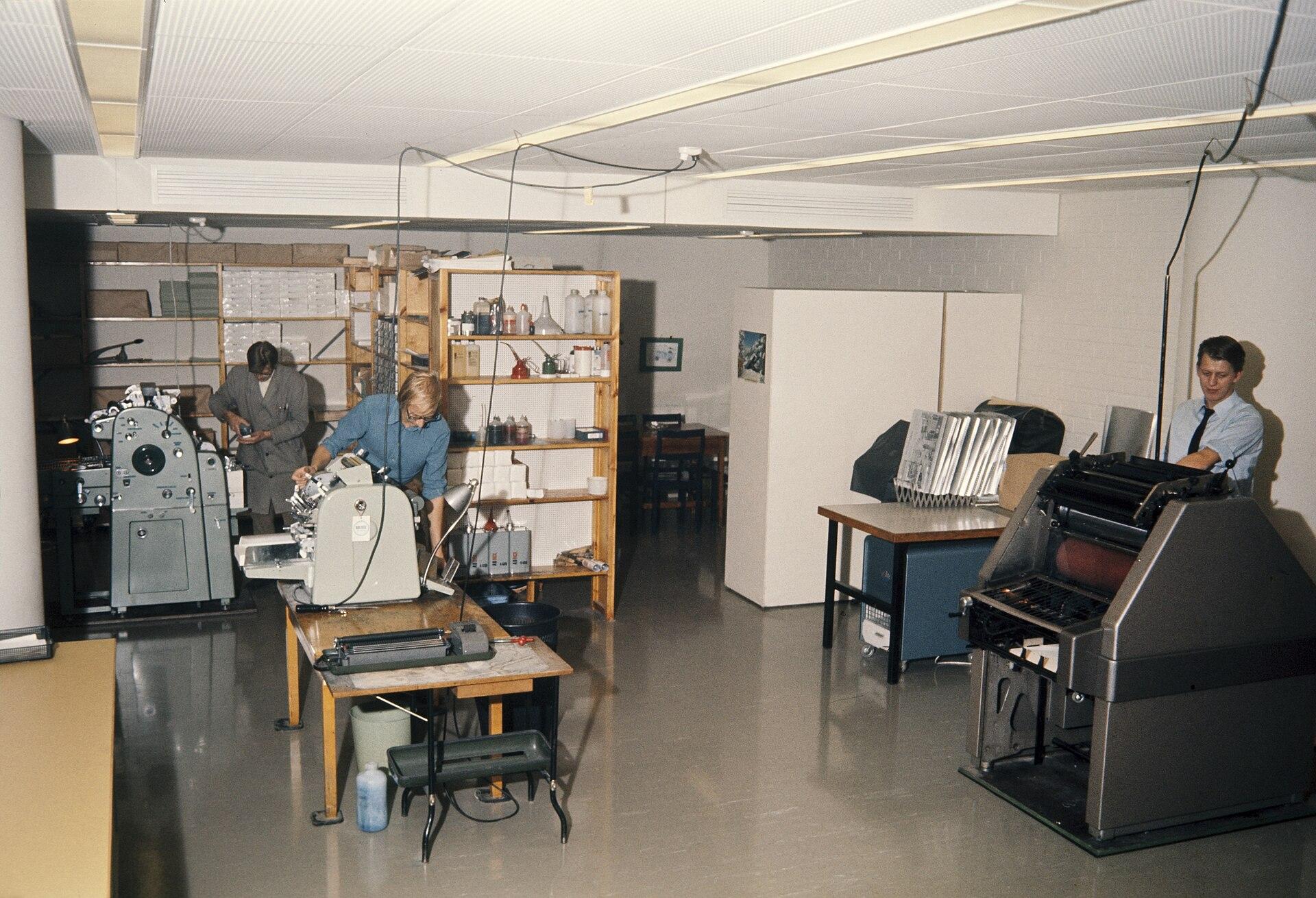
An office print room is usually pictured as a place: a back room of large machines, paper stock, and the smell of toner or duplicating fluid. The more useful way to see it is as a decision. An organisation that puts reproduction in a dedicated room has chosen to concentrate a capability rather than distribute it, and that choice — not the equipment — is what shaped how the office worked. The room is the visible form of a centralisation strategy.
Why output was centralised in a room
Centralisation was a response to cost, skill, and volume acting together. Reproduction equipment capable of serious output was expensive enough that buying one per desk made no sense; it was specialised enough that running it well was a learned competence rather than a casual act; and the demand for copies across a whole organisation was high enough to keep a shared machine usefully busy. When a capability is costly to own, demands skill to operate, and faces steady aggregate demand, pooling it in one place is the efficient answer. The print room was that answer made physical.
Seen this way, the room was the same kind of institution as the centralised mainframe or the typing pool: a scarce, capital-intensive resource concentrated and shared because concentrating it was cheaper than replicating it. The economics, not a preference for back rooms, put the machines together.

The print room as a department
Because it pooled a scarce resource, the room behaved like a service department rather than a piece of equipment. Work arrived as requests, often on a form specifying quantity, stock, and deadline. Output was scheduled rather than instant, with a turnaround time that everyone learned to plan around. Staff who ran the equipment accumulated expertise and, with it, an informal authority over what was feasible and what would have to wait. A request to the print room was a transaction with people, not an action taken alone at a machine.
This service-desk character is the part most easily lost in hindsight. Producing a stack of documents was not something a worker simply did; it was something they asked for, queued for, and collected — a workflow mediated by another team, with all the planning and negotiation that implies.
Centralisation as a chokepoint
Every concentrated resource is also a single point of contention, and the print room was no exception. The same pooling that made the equipment affordable made it a chokepoint: when many parts of the organisation needed output at once, the room's finite capacity forced prioritisation, and prioritisation is politics. Whose deadline counted, whose large job could be deferred, and who could obtain an exception became questions decided by schedule and by the standing of the requester. The archive's account of early network printing systems traces how the same dynamic — a queue, and an authority over it — reappeared at the level of a shared device; the print room shows it operating at the level of a whole department.
What desktop printing dismantled
The room's logic held only while reproduction stayed expensive, skilled, and worth centralising. Cheap, simple desktop devices attacked all three conditions at once: when a competent printer cost little, needed no specialist to run, and sat within reach of the desk, the economic case for routing routine output through a central department collapsed. Producing a handful of copies oneself became faster and cheaper than requesting them, and the steady stream of small jobs that had justified the room drained away to the desks. The shift in workplace habits this produced is developed in the archive's evolution of office printing.
What survived centralisation was the work that still rewarded it: high volumes, specialised finishing, and output where unit cost at scale still beat the convenience of the desktop. The room did not vanish so much as narrow to the jobs whose economics had not changed.
What the print room left behind
The most useful legacy of the print room is the pattern it reveals. Output centralised when reproduction was costly and skilled; it decentralised when reproduction became cheap and simple; and it partly re-centralised when organisations rediscovered that a sprawl of desktop devices carried its own hidden costs in supplies, support, and security. Managed print fleets and centrally administered print servers — examined in the archive's pages on print servers in large offices and enterprise document management — are the room's descendants, concentrating control even where the hardware stays distributed. The room itself was just one swing of a pendulum between concentrating a capability and spreading it, and the office has been swinging on it ever since.
Frequently asked questions
- Was the office print room just a room full of copiers?
- It is better understood as an organisational form: the decision to centralise reproduction in one staffed, scheduled department. The equipment was the visible part, but the room's defining feature was concentrating a costly, skilled capability rather than distributing it.
- Why did offices centralise printing instead of giving everyone a printer?
- Because early reproduction equipment was expensive to own, demanded skill to operate, and faced steady organisation-wide demand. When a capability has all three properties, pooling it in one place is cheaper than duplicating it at every desk.
- What ended the print room?
- Cheap, simple desktop devices removed the cost and skill barriers that justified centralising. Once producing a few copies oneself was faster and cheaper than requesting them, routine output decentralised to the desk, leaving the room only the high-volume and specialist jobs whose economics had not changed.
Continue in the archive
Related reading
History · The managed print fleet
Print Servers in Large Offices
At scale, the print server stopped being a way to share a device and became an instrument of governance — metering, quotas, defaults, and fleet control.
History · Decoupling the request from the print
Spoolers and Print Queues
Spooling solved an economic problem before a technical one: how to keep a slow, expensive printer fully used while never making a fast computer or its user wait.
History · The shared-office era
The Evolution of Office Printing
How printing in the office became shared infrastructure — a contended, managed resource rather than a personal device on a desk.
History · The managed-document enterprise
Enterprise Document Management
How organisations moved from filing cabinets to managing documents as governed records: captured, indexed, retrieved, retained, and disposed of by rule.