Key takeaways
- Business faxing is best understood as a change in commercial tempo, not a change in office equipment.
- Sending a signed page in minutes rather than days altered how negotiations were paced and how distance was priced.
- Fax became infrastructure precisely when people stopped noticing it, and the habits it created outlived the conditions that justified them.
The document-delay problem before fax
Before a document could cross a distance in minutes, the speed of business was the speed of a physical page in transit. A contract dispatched on Monday was a contract that could not be countersigned before Thursday, and every party to a transaction planned around that latency whether they articulated it or not. Distance was not merely inconvenient; it was a cost embedded in the schedule of every multi-party agreement.
Telephone and telegram had already shown that information could move fast. What they could not move was the document itself — the page with the figures, the terms, the signature. A deal could be discussed in real time and still stall for days waiting for the paper that made it binding. The constraint that mattered was not communication but the transmission of an artefact, and that is the specific gap fax addressed.
How instant remote documents changed deal-making
Once a signed page could reach a counterparty in minutes, the cadence of negotiation tightened around the new latency. Offers and counter-offers that had been measured in postal round-trips could be exchanged within a single working day. The effect was not simply faster work; it was a different shape of work, in which decisions were expected sooner because the document that demanded them now arrived sooner.
This compression of tempo had a cause-and-effect logic worth stating plainly. Faster document movement raised the expectation of faster response, which in turn raised the expected pace of the whole transaction. The friction of distance was not removed so much as repriced: where geography had once added days to a deal, it now added minutes, and parties reorganised their behaviour around the cheaper price. The mechanics of how a page actually made that journey are detailed in the archive's account of how fax machines work; what concerns the business history is the effect of that journey on how organisations bargained.
Fax as critical business infrastructure
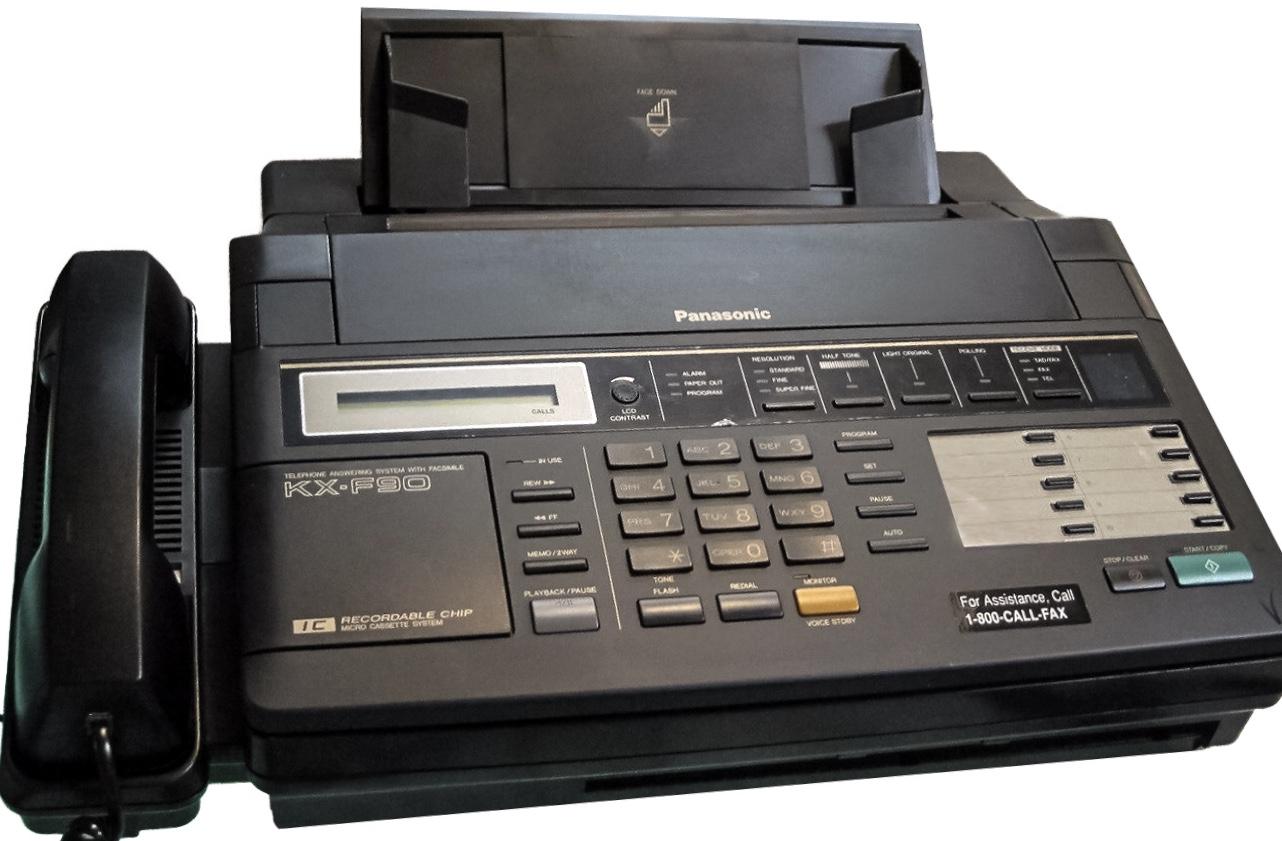
A technology becomes infrastructure at the moment it stops being a choice. For a long stretch, transacting without fax was not a stylistic preference but a competitive disadvantage: a firm that could not receive a signed page quickly was a firm that other parties routed around. The fax number became as expected on a letterhead as a telephone number, and its absence read as an absence of basic commercial readiness.
Infrastructure is defined by what fails when it is gone, and by that test the office fax qualified. An organisation whose machine was out of paper or off the hook was not merely inconvenienced; it was, for the duration, partly unreachable for the purpose of closing business. The general arc by which fax reached this status and later receded is traced in the archive's history of fax machines, which situates the office adoption within the longer technical story.
.jpg)
The workflow habits fax created
Routine technologies leave behind routine behaviours, and fax left a distinctive set. The cover sheet became a small bureaucratic form in its own right, carrying routing, page count, and a confirmation that the transmission was complete. Confirmation reports were filed as evidence that a document had been sent and received. Sending and re-sending until a clean copy arrived became an accepted part of getting a document across.
These habits mattered because they outlasted the urgency that produced them. A workflow learned under pressure becomes the default when the pressure is gone, and offices kept faxing in patterns shaped by an era when faxing was the fastest option available. The friction that fax once removed from distance had been traded for a different, quieter friction of process — cover sheets, confirmations, re-sends — and that traded friction was inherited intact by everyone who kept the habit.
The trade-offs businesses accepted
| What fax gave business | What it cost in exchange |
|---|---|
| A signed page delivered in minutes across any distance | A reconstructed image rather than an exact original, of variable legibility |
| A shared, universally understood channel needing no common computer system | A device, a line, and supplies that had to be staffed and maintained to stay reachable |
| A confirmation that a document had been transmitted and received | A paper trail that proved transmission, not that the right person had read or agreed |
| Negotiation tempo measured in minutes rather than postal days | An expectation of fast response that became permanent and non-negotiable |
None of these compromises was hidden. Businesses accepted a degraded, reconstructed copy because a fast adequate copy beat a slow perfect one when a deadline was real. They accepted the maintenance burden because being reachable was worth more than the cost of staying reachable. The trade was deliberate, and recognising that it was a trade is what makes the later decline intelligible rather than surprising.
What began to erode fax's necessity
Fax's necessity rested on a single assumption: that there was no faster way to put a document in front of a distant counterparty. Email and digital document exchange dissolved that assumption. They moved not a reconstructed image but an exact file, one that could be stored, searched, forwarded, and reproduced without loss — and they did so without the per-page line cost or the supply dependency of a machine.
The erosion was not instantaneous, because the habit was load-bearing and the legal weight attached to a faxed signature did not transfer to email overnight. That uneven, slow displacement — and the specific niches where fax held its ground — is the subject of the archive's pages on the decline of office fax machines and on why fax is still used; read alongside the account of fax in the years before email, they show that what business adopted as a tempo solution it kept, for a while, as an evidentiary one. The harder difficulty, in retiring it, was that fax had succeeded so thoroughly that the value it delivered had stopped being visible. A capability nobody notices is a capability nobody can plausibly cost or defend, and that invisibility — not the technology — was the real obstacle to letting it go.
Frequently asked questions
- Why did businesses adopt fax so widely rather than relying on phone and post?
- Phone moved conversation and post moved documents, but only slowly. Fax closed the specific gap neither could: it delivered the signed page itself across distance in minutes, which changed the tempo at which deals could realistically be closed.
- Did fax actually change how negotiations were conducted?
- Yes, indirectly. Faster document delivery raised the expectation of faster response, which tightened the cadence of offers and counter-offers. Distance stopped adding days to a transaction and started adding only minutes, and parties reorganised around that.
- Why did business faxing persist after email existed?
- The habit was deeply embedded and the legal and evidentiary weight attached to a faxed page did not transfer to email immediately. A workflow learned under pressure tends to remain the default long after the pressure that created it has gone.
Continue in the archive
Related reading
Fax · Introductory
How Fax Machines Work
How a fax machine scans a page, sends it over a telephone connection, and reconstructs it at the other end.
History · From early image transmission to the digital decline
The History of Fax Machines
How the idea of sending images over a distance developed into the office fax machine and its eventual decline.
Fax · Before the inbox
Fax Machines Before Email
What the working day looked like when the fastest way to put a document in someone's hands was a machine in the corner of the office.
Workflows
Scan to Searchable PDF
A repeatable workflow for turning paper documents into searchable, archival PDF files using scanning and OCR.
Modern tools
Contemporary apps for the same task, published by HELPERG LLC — the publisher of this archive.

Fax
Send and receive faxes from a phone or a browser, without a fax machine.