History
Xerox traces its origins to the Haloid Photographic Company, founded in Rochester, New York, in 1906 as a maker of photographic paper. Its transformation began with the work of Chester F. Carlson, a patent attorney and inventor who developed electrophotography and, assisted by physicist Otto Kornei, produced the first xerographic image on October 22, 1938, in Astoria, Queens, New York.
After being turned down by numerous established companies, Carlson signed a development agreement with the Battelle Memorial Institute in 1944. In 1947 Battelle licensed the commercial rights to the process to Haloid. Working with a suggestion from a classics scholar, the company adopted the term "xerography," from Greek roots meaning "dry writing." Haloid renamed itself Haloid Xerox in 1958 and Xerox Corporation in 1961.
The breakthrough product was the Xerox 914, the first successful plain-paper office copier, publicly demonstrated on September 16, 1959. Its commercial success funded major expansion, including the founding of the Palo Alto Research Center (PARC) in 1970, where Xerox researchers developed the laser printer along with computing technologies such as the graphical user interface, Ethernet, WYSIWYG editing, and the Alto computer. In later decades Xerox introduced the DocuTech digital publishing system (1990), reorganized into a holding-company structure (2019), and wound down its long-running Fuji Xerox joint venture.
Timeline
1906
Haloid Photographic Company founded in Rochester, New York.
1938
Chester Carlson produces the first xerographic image (October 22, Astoria, Queens).
1944
Carlson signs a development agreement with the Battelle Memorial Institute.
1947
Battelle licenses xerography commercial rights to Haloid.
1956
Rank Xerox joint venture formed with Britain's Rank Organisation for markets outside the Americas.
1958
Company renamed Haloid Xerox Inc.
1959
Xerox 914 plain-paper copier introduced (public demonstration September 16).
1961
Renamed Xerox Corporation.
1962
Fuji Xerox joint venture established in Japan (Fuji Photo Film and Rank Xerox, 50:50).
1963
Xerox 813, an early desktop plain-paper copier, introduced.
1970
Xerox Palo Alto Research Center (PARC) established.
1971
Gary Starkweather transfers to PARC to develop laser printing.
early 1970s
First working laser printer built at PARC.
1973
Xerox 6500 color copier introduced (May).
1977
Xerox 9700 laser printer launched.
1990
DocuTech Production Publisher (Model 135) introduced, launching print-on-demand.
1997
Xerox takes full ownership of Rank Xerox; the Rank Xerox name is discontinued.
2000
Xerox acquires Tektronix's color-printing (solid-ink) division, giving rise to the Phaser line.
2005
Xerox recognized with the U.S. National Medal of Technology for reprographics, digital printing, and print-on-demand.
2007
Headquarters relocated to Norwalk, Connecticut (October).
2019
Holding-company reorganization completed (July 31); Xerox Holdings Corporation becomes parent. Xerox agrees to sell its remaining Fuji Xerox stake to Fujifilm.
2021
Fuji Xerox renamed Fujifilm Business Innovation (April 1); Xerox stock moves from NYSE to Nasdaq (September).
2023
Xerox donates PARC to SRI International.
Printing technologies
- Xerography / electrophotography — dry, plain-paper copying using an electrostatically charged photoconductor, toner, and heat fusing; the company's foundational technology.
- Laser printing — computer-driven laser exposure of a xerographic drum, invented at Xerox by Gary Starkweather, with the prototype built at PARC in the early 1970s and commercialized in the Xerox 9700 (1977).
- Digital production printing — high-resolution scanning combined with laser imaging and xerography, integrated in the DocuTech system (1990).
- Color xerography — introduced with the Xerox 6500 color copier (1973) and extended through later color product lines.
- Solid-ink and inkjet printing — solid-ink (Phaser and ColorQube) technology acquired via Tektronix's color-printing division (2000), with production inkjet lines added later.
Major printer families
- Xerox 914 / 813 — early plain-paper copiers.
- Xerox 6500 — early Xerox color copier.
- Xerox 9700 — production laser printer.
- DocuTech — digital publishing and print-on-demand.
- DocuColor / DocuPrint — digital color and office printing.
- iGen — digital production color press.
- Nuvera — production monochrome.
- Phaser — office solid-ink and laser printers.
- WorkCentre — multifunction devices.
- ColorQube — solid-ink multifunction devices.
- VersaLink and AltaLink — later office multifunction lines.
- Impika / Trivor / Rialto / iPrint — production inkjet.
Product areas
Xerox has organized its output technologies across several broad markets.
- Enterprise and office — multifunction printers and copiers (WorkCentre, VersaLink, AltaLink) together with managed print and document services.
- Industrial and production printing — high-volume digital presses and print-on-demand systems (DocuTech, iGen, Nuvera, production inkjet).
- Consumer and small office — desktop laser and solid-ink printers such as the Phaser line.
Xerox also historically offered document-services and business-process outsourcing, notably through Affiliated Computer Services (acquired 2010); that services business was later spun off as Conduent (2017). Fax capability existed within multifunction devices, but fax was not a defining standalone Xerox product line.
Major innovations
- Commercialization of xerography and the first successful plain-paper office copier, the Xerox 914.
- Invention of the laser printer by Gary Starkweather at PARC.
- Integrated digital print-on-demand publishing with the DocuTech system.
- PARC computing innovations adjacent to printing, including the graphical user interface, Ethernet, WYSIWYG editing, and the Alto computer, which shaped the personal-computing and networked-printing ecosystem.
- Recognition with the U.S. National Medal of Technology (2005) for its contributions to reprographics, digital printing, and print-on-demand.
Influence on printing history
Xerox's commercialization of xerography made document reproduction fast, dry, and inexpensive on ordinary paper, reshaping office work and giving rise to the generic use of "xerox" as a verb for photocopying. Its invention of the laser printer at PARC became one of the most influential output technologies in computing, underpinning modern digital printing.
The DocuTech system helped establish the print-on-demand and short-run digital-publishing industries, decoupling printing from long fixed press runs. PARC's broader innovations, including the graphical user interface, Ethernet, and WYSIWYG editing, shaped the networked, desktop-publishing environment in which digital printing operates.
Relationships with other manufacturers
- Battelle Memorial Institute — early research and development partner that licensed xerography rights to Haloid in 1947.
- Rank Organisation (Rank Xerox) — joint venture from 1956 covering markets outside the Americas; Xerox took full ownership in 1997.
- Fuji Photo Film / Fujifilm (Fuji Xerox) — joint venture established in 1962 between Fuji Photo Film and Rank Xerox; Xerox sold its remaining stake to Fujifilm in 2019, and the entity was renamed Fujifilm Business Innovation in 2021.
- Tektronix — Xerox acquired its color-printing (solid-ink) division in 2000, giving rise to the Phaser line.
- Apple — Apple's Lisa and Macintosh interface development was influenced by demonstrations of PARC's technology, as widely documented in computing history.
- Xerox later competed in laser printing with firms such as IBM, Canon, and Hewlett-Packard.
Legacy technologies
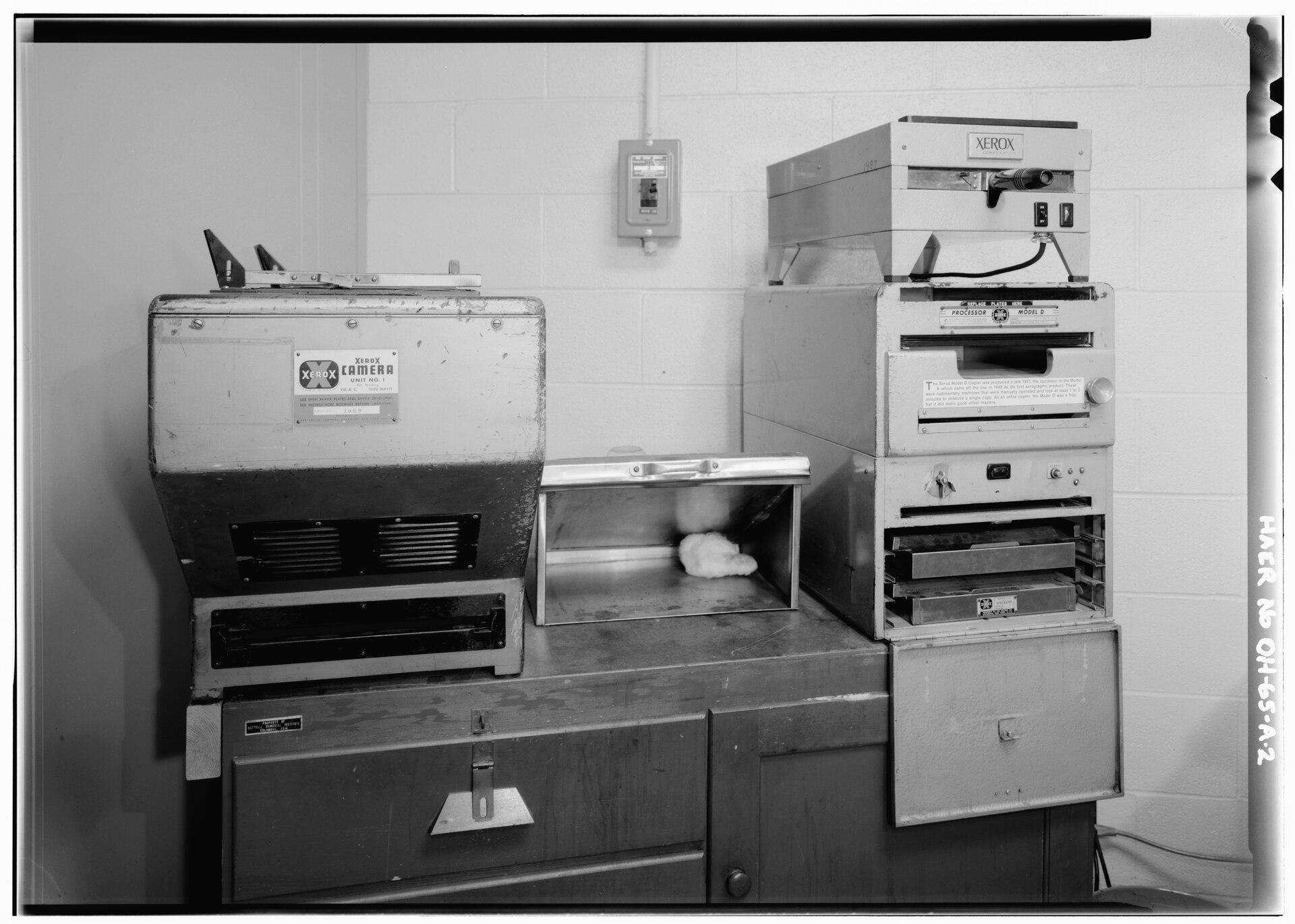
Several Xerox technologies mark turning points in printing and computing history. The Xerox 914 established plain-paper office copying, and the early Model A xerographic product of the late 1940s represented the first manually operated commercial application of the process.
At PARC, the Alto computer, the graphical user interface, WYSIWYG editing, and Ethernet formed an integrated vision of interactive, networked computing, with the laser printer as its output device. The Xerox 9700 carried laser printing from prototype to a marketed production system, and the DocuTech system later fused scanning, laser imaging, and xerography into digital production publishing. Xerox donated PARC to SRI International in 2023, retaining certain patent rights.
Current status
Xerox continues to operate as Xerox Corporation, a wholly owned subsidiary of Xerox Holdings Corporation, the parent entity created in the 2019 reorganization. The company is headquartered in Norwalk, Connecticut, and has been publicly traded on Nasdaq since 2021.
Its focus areas include office and production print hardware, managed print and document services, and related software. In 2023 Xerox donated its Palo Alto Research Center to SRI International, closing a chapter that had begun with the center's founding in 1970.
Frequently asked questions
- Who invented xerography?
- Xerography was invented by Chester F. Carlson, a patent attorney and inventor, who produced the first xerographic image on October 22, 1938, in Astoria, Queens, New York, assisted by physicist Otto Kornei. The commercial rights were later licensed to the Haloid Company, which became Xerox.
- What was the Xerox 914?
- The Xerox 914 was the first successful plain-paper office copier, publicly demonstrated on September 16, 1959. Its commercial success funded major expansion, including the founding of the Palo Alto Research Center in 1970.
- Did Xerox invent the laser printer?
- Yes. The laser printer was invented at Xerox by Gary Starkweather, who built the prototype at the Palo Alto Research Center (PARC) in the early 1970s. Xerox commercialized laser printing with the Xerox 9700 in 1977.
- What is DocuTech?
- DocuTech was a digital production publishing system introduced by Xerox in 1990. By combining high-resolution scanning with laser imaging and xerography, it helped establish the print-on-demand and short-run digital-publishing industries.
- What happened to Fuji Xerox?
- Fuji Xerox was a joint venture established in 1962 between Fuji Photo Film and Rank Xerox. Xerox sold its remaining stake to Fujifilm in 2019, and the entity was renamed Fujifilm Business Innovation in 2021.
Source transparency (12 sources)
These references support claims made in this entry. The archive uses verified institutional and public-domain sources only; see Source policy.
Sources consulted (12)
- The Story of Xerography — Xerox
- Chester F. Carlson | Xerography, Photocopying, Electrophotography — Encyclopaedia Britannica
- October 22, 1938: Invention of Xerography — American Physical Society
- Story of the First Xerography Experiments — Smithsonian National Museum of American History
- Xerox 914 Plain Paper Copier — Smithsonian National Museum of American History
- Laser Printers — CHM Revolution — Computer History Museum
- NIHF Inductee Gary K. Starkweather — National Inventors Hall of Fame
- 25th Anniversary of Xerox DocuTech — Xerox Newsroom
- Xerox To Complete Holding Company Reorganization — Xerox Newsroom
- Xerox Holdings Corp Form 10-Q FY2019 — U.S. Securities and Exchange Commission
- Corporate History — Fujifilm Business Innovation
- National Medal of Technology and Innovation — 2005 Recipients — U.S. Patent and Trademark Office
Continue in the archive
Related reading
History · The early laser era
How Early Laser Printers Worked
Early laser printing was an institutional instrument before a personal one — a centralised capital asset that changed who could command typeset-quality pages.
History · From specialised equipment to mainstream office printing
The Evolution of Laser Printing
How laser printing developed from a specialised technology into a standard for fast, sharp office output.
Guides · Introductory
How Laser Printers Work
How a laser printer turns a digital page into printed output using static charge, toner, and heat.
History · The page on the desk
The History of Desktop Publishing
How the production of a finished page collapsed from a multi-trade workflow into a single desk — and what that displaced.