
Key takeaways
- Early laser printing was, first, a centralised capital asset — its economics shaped access before its mechanism shaped pages.
- Electrophotography formed a whole page as a coherent image, which is what made typeset-grade output ordinary rather than exceptional.
- Because it was institutional, it concentrated high-quality output at controlled points before later cost decline made it personal.
The output ceiling offices hit before laser
Before early laser, an organisation that wanted genuinely professional pages faced a ceiling. In-house methods produced output that was unmistakably office-made; output that looked typeset required sending work outside, with the delay, cost, and loss of control that implied. The constraint was not that offices could not print — they printed constantly — but that the gap between everyday internal output and presentation-grade output was a wall, crossed only by leaving the building. Early laser is best understood as the thing that brought one side of that wall indoors.
Framed this way, the interesting question is not how the mechanism worked but what ceiling it lifted and for whom — a question the archive's history of desktop publishing pursues from the document-creation side, and which this page approaches from the output side.
What electrophotography changed about a page
An early laser printer forms a page by electrophotography: a controllable light source writes a latent electrostatic pattern onto a photoconductive surface, that pattern attracts fine toner powder, the toner is transferred to paper, and heat fuses it permanently. The general mechanism is detailed in the archive's guide to how laser printers work; the historically decisive feature is that the page is composed as a single coherent image rather than assembled element by element. That is precisely why the output read as typeset rather than printed — uniformity across the whole page, not refinement of an individual character, is what crosses the perceptual line between produced and professional.
The toner-and-fusing process — the powder is the subject of the archive's entry on toner — also gave a durable, consistent result that did not depend on a striking force or a fluid. The page no longer carried the signature of the mechanism that made it.
Why early laser was an institutional, not personal, tool
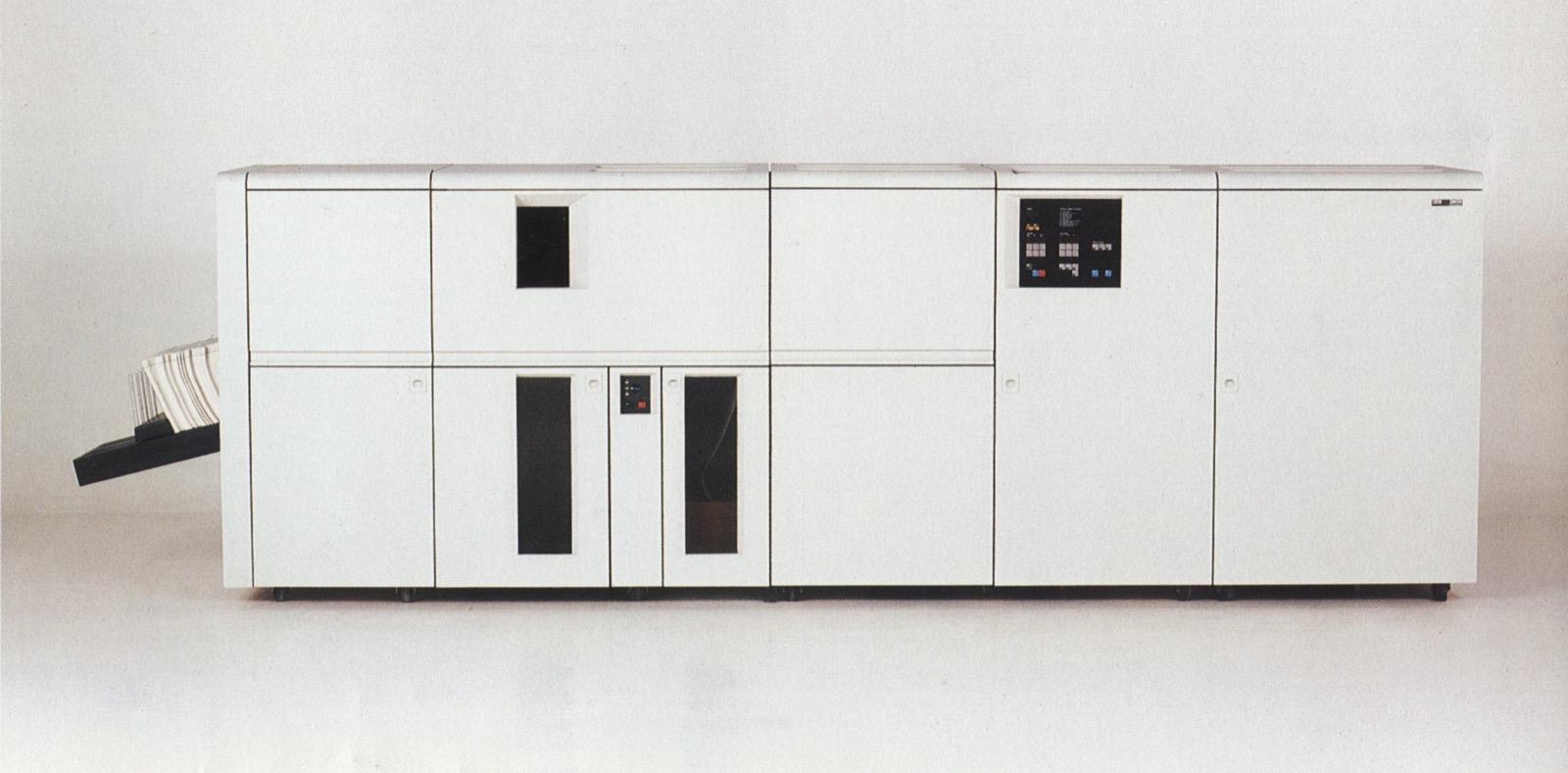
This is the analytical centre of the page. The early laser printer was a substantial capital item, which placed it firmly on the institution's balance sheet rather than at an individual's desk. That economic fact, not the optics, set its social role. A capability that is expensive is necessarily shared, sited deliberately, and controlled, so professional-grade output became something an organisation possessed at chosen points rather than something a worker had to hand. Who could command such a page was, in the early period, an organisational question before it was a technical one.
Early laser did not give every desk a typeset page. It gave the organisation a place where typeset pages came from.
How it reorganized document production
Because the capability was sited and shared, document production reorganised around it much as it had around other shared printing — but with a difference in kind. This was not merely a faster shared printer; it was the shared point at which a document acquired a quality it could not acquire elsewhere in the building. Workflows formed a distinction between routine output, made anywhere, and presentation output, routed to the laser. The archive's evolution of laser printing traces how that distinction later dissolved as the technology spread; in the early period the distinction was sharp, and it structured how and where finished documents were produced.
The cost and access trade-offs
The trade-offs were the characteristic ones of any scarce, high-value, centralised resource, and they pulled against each other. Centralising the capability made its quality affordable at all by amortising a large cost across an organisation — but it also gated access, inserted distance and queuing between a worker and a finished page, and concentrated dependence on a small number of expensive machines. The early laser bargain was explicit: an organisation obtained a quality ceiling it could not otherwise reach, and paid for it in access friction and concentrated risk rather than in per-page running cost.
The path from shared laser to ubiquity
The path forward was set by the same economics that defined the start. As the cost of the capability fell, the reason for centralising it weakened, and a resource that had to be shared because it was expensive could progressively be distributed because it no longer was. The access friction that had been the price of the early bargain was, in effect, refunded as the technology cheapened. The wider arc — and the office-side consequences of laser becoming the ordinary baseline — is treated in the archive's evolution of office printing. Read in that frame, the operative shift is plain: an institutional capital asset migrated, over time, into an ordinary desk device, and the cheapening is what made the migration possible. When the price of producing such a page fell far enough, the organisational gatekeeping around it stopped being necessary, and a quality once secured by an institution's purchase became something an individual could simply use.
Frequently asked questions
- Why frame early laser printing as an institutional tool rather than a printing advance?
- Because its cost set its social role. It was a capital asset that an organisation owned and sited, so professional-grade output became something an institution possessed at controlled points rather than something individuals had. Who could command such a page was an organisational question first.
- What did electrophotography actually change about the page?
- It let the whole page be formed as one coherent image rather than assembled element by element. That page-wide uniformity, not the refinement of a single character, is what crossed the line from output that looked office-made to output that looked typeset.
- Why did early laser eventually become personal?
- Because the only strong reason to centralise it was cost. As the capability cheapened, the rationale for sharing weakened, so a resource shared because it was expensive could be distributed once it no longer was. The early access friction was, in effect, refunded by falling cost.
Continue in the archive
Related reading
Guides · Introductory
How Laser Printers Work
How a laser printer turns a digital page into printed output using static charge, toner, and heat.
History · From specialised equipment to mainstream office printing
The Evolution of Laser Printing
How laser printing developed from a specialised technology into a standard for fast, sharp office output.
History · The page on the desk
The History of Desktop Publishing
How the production of a finished page collapsed from a multi-trade workflow into a single desk — and what that displaced.
Glossary · Definition
Toner
Toner is the fine powder used by laser and LED printers to form images, fused to the page with heat and pressure.