Key takeaways
- In the 1980s the printer was a mechanical instrument the worker operated, not a service the worker dispatched to.
- Continuous-form paper and impact output dictated desk layout, document handling, and the rhythm of the working day.
- The decade's newer printing options were quieter and sharper but introduced cost and per-sheet handling that the impact base did not have.
The 1980s desk and its document reality
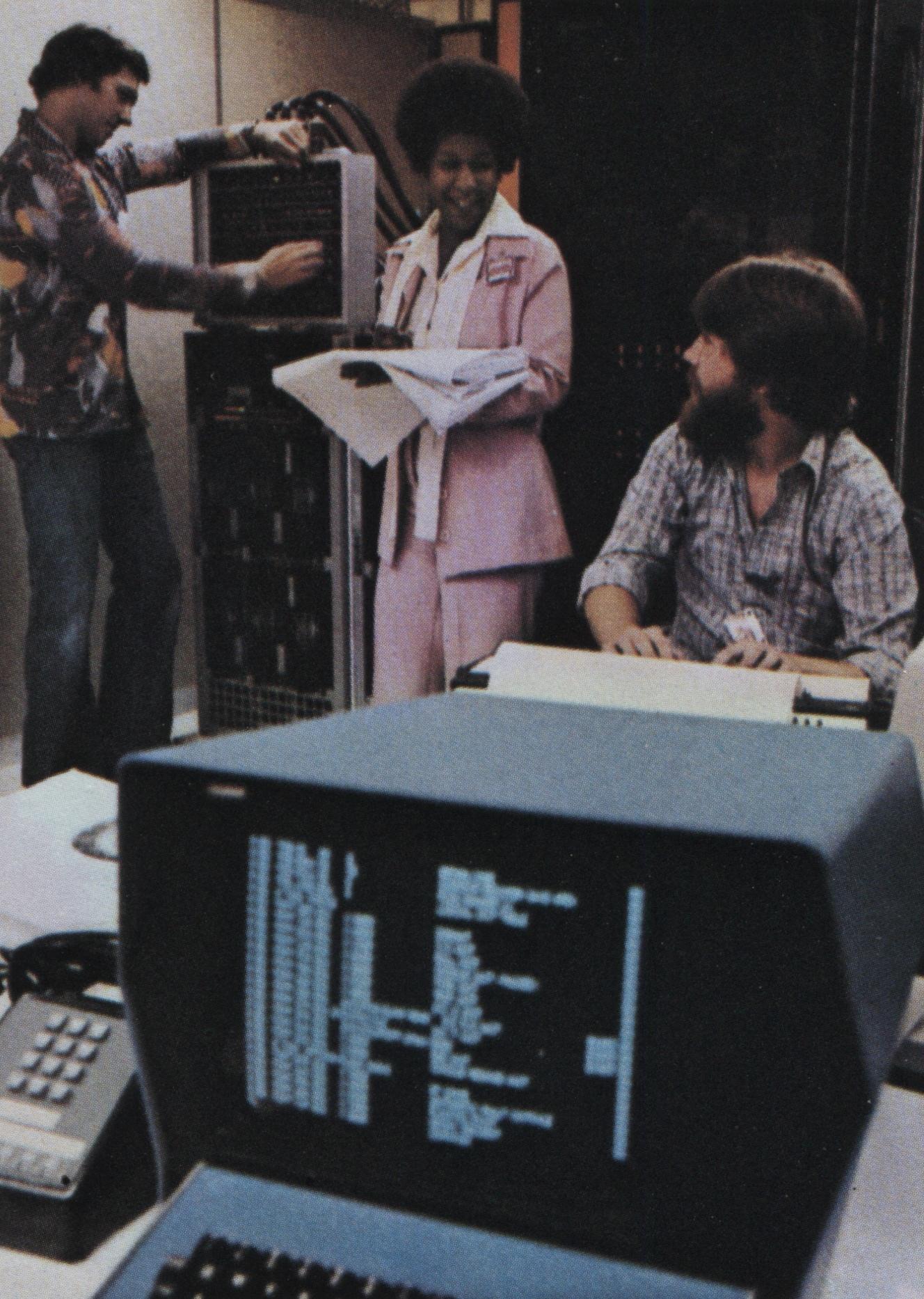
Consider the desk first, because the desk explains the decade. A worker producing printed output in the 1980s did not simply ask for a document and receive it. They sat beside a machine that consumed a folded stack of continuous paper, drove it through a mechanism by sprocket holes along each edge, and delivered the result as one unbroken concertina that then had to be separated and have its perforated margins removed. The page was not a discrete thing that appeared; it was a length of a longer thing that the worker physically resolved into pages.
That single fact propagated outward into the whole workspace. The machine needed a clear path for paper to enter and a clear path for it to exit and pile up, so it claimed a footprint disproportionate to the rest of the desk. Boxes of fan-fold stock had to be stored within reach. The result was that the document, far from being weightless, was one of the heaviest and most space-consuming objects a clerical worker dealt with daily.

What impact-era output dictated about work
Impact output, formed by driving small striking elements against an inked ribbon and the page, carried implications that reached well past print quality. Because the image was made by mechanical force transmitted through the paper, the same strike could mark several interleaved sheets at once. This is the property the archive's account of how dot matrix printers work treats in detail, and in the 1980s it was not a curiosity but a load-bearing part of office procedure: invoices, dispatch notes, and ledgers existed as multi-part sets because the printer could create the copies in the act of printing the original.
The trade-off was accepted plainly. Striking paper hard enough to mark a carbon set is a noisy operation, and graphical fidelity was poor because the image was assembled from a coarse field of struck points. Offices did not regard this as a defect to be fixed so much as the cost of a capability nothing else delivered: durable, cheap, simultaneous copies on stationery that needed no special handling.
The arrival of new printing options and their friction
During the decade, quieter and visually sharper output became available to offices that could justify it. The significance was less the improved letterform than the change in what a document signified: correspondence that had previously looked unmistakably machine-made could now resemble typeset material. But the newer options did not simply replace the impact base. They cut paper as discrete sheets rather than feeding a continuous web, which removed the bulk and the tearing but also removed the built-in multi-part copy and introduced a per-sheet cost and a per-sheet handling step.
So the decade did not experience a clean substitution. It experienced a split: a loud, cheap, copy-capable machine for transactional volume, and, where it could be afforded, a quieter machine for documents whose appearance now mattered. The longer arc of that divergence is the subject of the archive's account of the transition from impact to laser printing; within the 1980s itself the two simply coexisted, each doing what the other did badly.
How the workday adapted around the printer
Because the machine set the pace, the worker organised the day around it. A long run was started and then attended intermittently: paper could misfeed, the ribbon faded gradually and had to be judged and changed, and the continuous output had to be guided so it folded back into a stack rather than spilling. Printing was not an instant at the end of a task; it was an interval of supervised machine operation that the worker scheduled into the day like any other process with a duration.
This had a quiet consequence for how work was sequenced. Knowing that output took measurable time and attention, workers batched it — assembling several documents and committing them together rather than printing each as it was finished. The printer thus shaped not only the desk but the order in which tasks were done.
The constraints operators simply lived with
Several limits of the era were not solved during it; they were absorbed into normal practice. Noise was managed by placement and acoustic hoods rather than eliminated. Graphical weakness was managed by not asking the machine for graphics. The labour of bursting continuous stock into sheets and stripping its margins was simply part of producing a document. None of this read as hardship to the people doing it, because there was no contemporaneous alternative against which it registered as friction — a point worth holding when later decades made the same tasks look antiquated.
What the decade set up next
The 1980s ended with two unresolved tensions that the following decade inherited directly. First, the per-desk machine was an obvious inefficiency once quieter, sheet-fed output existed, which pointed toward sharing. Second, output that now looked typeset raised the expected standard for every document, transactional ones included. Both tensions are taken up in the archive's account of printing in the 1990s, which treats the shared machine and the escalating expectation as the defining problems of the decade that followed. The 1980s did not solve them; it made them unavoidable.
Frequently asked questions
- Why was continuous-form paper so central to 1980s office printing?
- Impact printers were driven by sprocket holes along a continuous web of fan-fold paper rather than fed discrete sheets. That single mechanical fact dictated desk layout, storage, and the post-printing labour of separating and trimming pages, so it shaped the whole working environment, not just the output.
- Did quieter printing simply replace impact printing in the 1980s?
- No. Quieter, sharper output coexisted with impact rather than displacing it, because it lost the built-in multi-part copy and added per-sheet cost and handling. Offices ran both: impact for transactional volume and copies, the newer option where a document's appearance mattered.
- Why frame the decade around the machine rather than the document?
- Because in the 1980s the worker operated the printer rather than dispatching to it. The machine's pace, footprint, and tending requirements organised the desk and the order of tasks, so the operational reality of the era is best understood from the machine outward.
Continue in the archive
Related reading
History · The impact-printing era and its lasting niches
Dot Matrix Printers Explained
What dot matrix printers are, how impact printing works, and why the technology persisted in specific roles.
History · The networked-office decade
Office Printing in the 1990s
How the 1990s office shifted toward shared networked printers, laser output, and document-centric workflows.
History · From the hammer to the page
The Transition from Impact to Laser Printing
Why offices moved from striking paper to forming pages with light and toner, and what that shift gained and gave up.
History · The 1990s office
Printing in the 1990s
The 1990s turned printing into a contested shared resource: queues, prioritisation, and the new office question of whose job ran next.