Key takeaways
- Impact printing's defining virtue was tolerance: it worked in poor conditions, on cheap supplies, with little maintenance.
- Forming the image by mechanical force made the process robust and its failure modes gradual and legible rather than abrupt.
- Refined non-impact methods won where conditions were good and appearance mattered; impact's forgiveness still defines its surviving niche.
Printing when the page had to be struck
Begin with the demand, not the device. Many settings that needed printed output were not clean, climate-controlled offices: they were stockrooms, counters, workshops, and back rooms where dust, temperature swings, and indifferent attention were normal. What such places needed was not the finest possible page but a page that appeared reliably under conditions that were frankly hostile to precision machinery. Impact printing answered that demand, and its whole character is best read as a set of properties suited to unfavourable environments.
This is a different lens from the one in the archive's account of how dot matrix printers work, which examines the multi-part copy. Here the question is broader: not what impact uniquely produced, but why a method that struck the page proved so resilient where gentler methods struggled.
The mechanics in service of the workflow
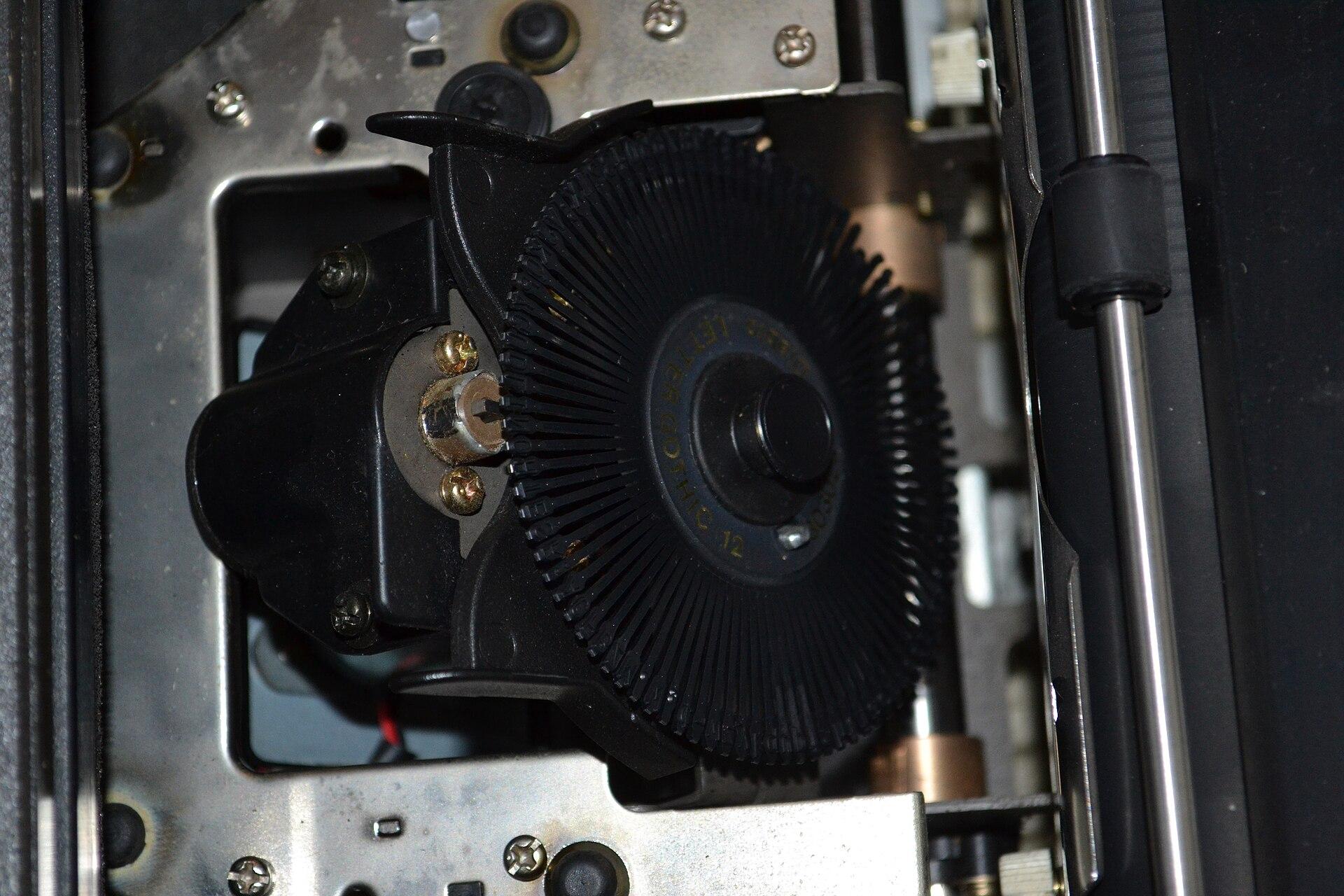
An impact printer forms its image by driving a striking element through an inked ribbon against the page, transferring ink by force. The mechanically significant point is that the process is coarse in a useful way. It does not depend on precise fluid chemistry, fine thermal control, or delicate electrostatics; it depends on a robust mechanism delivering a blow and a simple ribbon supplying ink. Coarse tolerances are forgiving tolerances, and a process with few sensitive variables has few things that environmental insult can spoil.
So the mechanics served the workflow not by being sophisticated but by being indifferent — to humidity, to dust, to a ribbon past its best, to a building that was too hot or too cold. The blunt instrument was the point.

What impact made reliable and cheap
Two properties followed directly from that bluntness. The first was reliability of outcome: within wide limits, a strike either marked the page or did not, with little in between to go subtly wrong, so output was predictable even when circumstances were not. The second was cost. The consumable was an inked ribbon — about the simplest, cheapest supply a printing method can have — and ordinary uncoated paper sufficed. A method that is robust and runs on the cheapest possible inputs is, for high-volume routine work, an extremely strong proposition regardless of how it looks.
| Property | What it enabled | Accepted cost |
|---|---|---|
| Image formed by mechanical force | Works in poor conditions; few sensitive variables | Inherently loud; physics cannot be quieted away |
| Coarse process tolerances | Forgiving of dust, humidity, neglect, worn supplies | Output legible rather than refined |
| Ribbon-and-plain-paper consumables | Very low running cost at high volume | Slow gradual fade demands operator judgement |
| Mechanical, simple failure modes | Gradual, legible degradation rather than sudden stop | Speed limited by mechanically building each character |
The noise, speed, and quality the office tolerated
The costs were real and were paid knowingly. Striking paper is loud, and because the noise is intrinsic to the method it could be muffled but not removed. Building each character mechanically is not fast. The struck image is legible rather than handsome. Offices tolerated all three because they were buying something specific in return — output that kept appearing in conditions and at a running cost that refined methods could not match. Tolerance of the costs was the rational price of the method's forgiveness, not resignation.
The pressures that ended impact's dominance
Impact lost its general dominance where its compensating virtues stopped paying. In clean offices producing correspondence and reports, conditions were not hostile, so the forgiveness was wasted capability, while the costs — noise especially — were felt every working hour. Once quieter, refined methods were affordable for that setting, the trade reversed: the office no longer needed tolerance and was no longer willing to pay noise for it. The archive's transition from impact to laser printing follows that reversal in full. Crucially, impact was not beaten on its own terms; the environment that made its terms valuable simply ceased to be where most printing happened.
Impact's residual niche
Impact endures precisely where its founding logic still holds: environments that remain hostile to delicate machinery, workloads where running cost dominates and appearance does not, and uses that need a process whose failures are gradual and readable rather than sudden and opaque. Seen across the whole arc — the long view is the archive's general history of printers — impact's persistence is consistent with everything above. It was never the method that printed best; it was the method that kept printing when conditions were against it, and that virtue, unlike refinement, never went out of demand where the conditions still apply.
Frequently asked questions
- What was impact printing's most important property?
- Tolerance, not the multi-part copy or even durability in isolation. Its coarse, force-based process had few sensitive variables, so it kept working in dust, heat, humidity, and neglect that defeated more refined methods — and it failed gradually rather than abruptly.
- Why did impact printing lose its dominance?
- Because its forgiveness stopped paying where it was no longer needed. In clean offices the tolerance was wasted while the noise was felt constantly, so once quiet refined methods were affordable there, the trade-off reversed. It was displaced by context, not beaten on its own terms.
- Why does impact printing still have a niche?
- Because its founding logic still applies in places: hostile environments, cost-dominated high-volume work, and uses that need legible gradual failure rather than sudden stoppage. Where conditions remain adverse, the virtue that justified impact has never gone out of demand.
Continue in the archive
Related reading
History · The impact-printing era
How Dot Matrix Printers Work
Dot matrix solved an office problem before it was a mechanism: cheap, durable, simultaneous multi-part copies created in the act of printing.
History · The impact-printing era and its lasting niches
Dot Matrix Printers Explained
What dot matrix printers are, how impact printing works, and why the technology persisted in specific roles.
History · From the hammer to the page
The Transition from Impact to Laser Printing
Why offices moved from striking paper to forming pages with light and toner, and what that shift gained and gave up.
History · From early printing to the digital era
The History of Printers
How printing technology progressed from early hand methods through mechanical presses to modern non-impact digital printers.