Overview
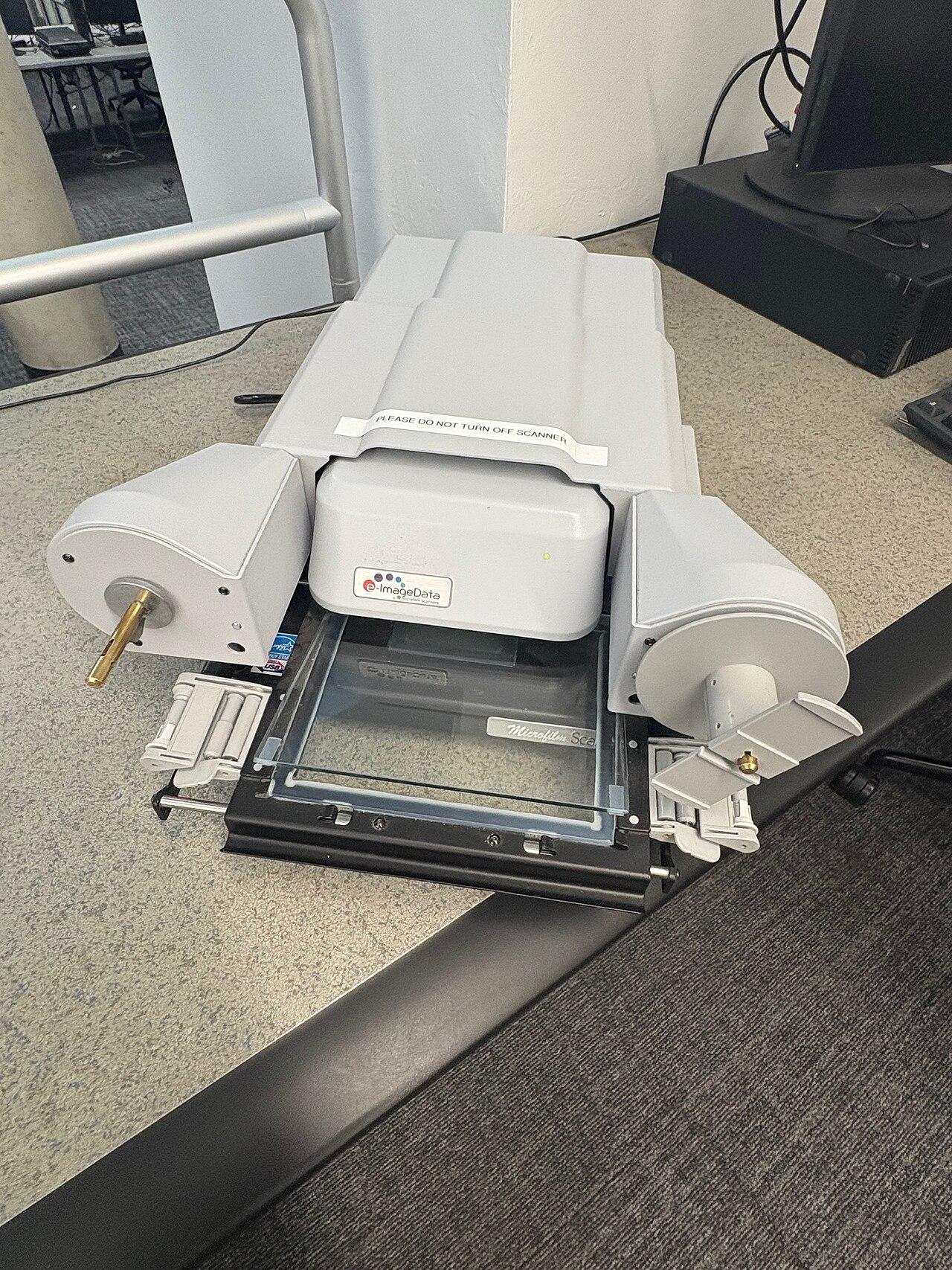
Microfilm digitization is the process of converting analog microforms — reduced-scale photographic images of documents recorded on film — into digital raster images and, usually, searchable text. Microforms include roll film (typically 16 mm and 35 mm), flat microfiche sheets, and aperture cards. Digitization is performed with specialized microform scanners that magnify, illuminate, and photograph each frame, producing image files that are then indexed, quality-controlled, and often processed with optical character recognition (OCR).
The practice sits at the intersection of two preservation eras. For most of the twentieth century, microfilming was the dominant preservation-reformatting technology for fragile paper, newspapers, and bulk records. Today, institutions increasingly digitize those existing microfilm collections to make them accessible online, while cultural-heritage and government bodies continue to weigh the respective roles of film and digital media for long-term retention. Authoritative guidance for the work comes principally from the U.S. National Archives and Records Administration (NARA), the Library of Congress-hosted Federal Agencies Digital Guidelines Initiative (FADGI), and the relevant ISO, ANSI, and AIIM micrographics standards.
History and origin
Microphotography — the recording of readable text at extreme reduction — predates practical microfilm by nearly a century. John Benjamin Dancer, frequently described as the "father of microphotography," began experimenting with micro-reduced images around 1839 and was selling microphotographs as slides for viewing under a microscope by 1853. In 1859 the French optician René Dagron received what is generally cited as the first patent for microfilm and established an early commercial microfilming operation. Dagron's technology found a famous use during the Franco-Prussian War (1870–71), when microfilmed messages were carried into besieged Paris by pigeon post.
Commercial, records-oriented microfilm emerged in the 1920s. George McCarthy, a New York City banker, developed a machine to make permanent film copies of bank records and received a patent in 1925 for his "Checkograph." Eastman Kodak acquired the invention in 1928 and marketed it through its Recordak Division, initially using continuous 16 mm cameras to photograph cancelled checks. Recordak began filming and publishing The New York Times on 35 mm microfilm in 1935, launching the use of microfilm to preserve fragile newsprint. In 1938 Eugene Power founded University Microfilms, Inc. to microfilm doctoral dissertations and rare materials. During World War II, microfilm underpinned "V-mail," in which letters to and from service members overseas were photographed onto film to save shipping weight and space.
What it is
A microform is a photographic reproduction of documents at a known reduction ratio — for example, 8× or 24×, meaning the filmed image is one-eighth or one-twenty-fourth the linear size of the original. Microfilm digitization is the reverse-and-forward operation: the film image is optically magnified back toward original scale, captured by a digital sensor, and saved as an image file.
Digitization from microfilm is distinct from digitizing paper directly. The source is already a photographic intermediate, so image quality is bounded by the quality of the original filming — its resolution, density, contrast, and any defects. A well-known consequence, noted explicitly in the FADGI guidelines, is that the original document's physical size can only be reconstructed from a scan if the reduction ratio is known or a physical scale was filmed in the frame, which is not standard practice.

How it works
A microform scanner typically comprises a transport or platen to position the film, a light source, a magnifying lens matched to the film's reduction ratio, and a digital image sensor. Reported CCD-based systems capture grayscale at 8 bits per pixel and color at higher bit depths (for example, 36 bits per pixel in some linear-array color scanners); these figures are common practitioner and vendor norms rather than standards. Roll-film scanners advance 16 mm or 35 mm film past the sensor, often with motorized transport and frame detection; microfiche and aperture-card scanners use a flat carriage and a condenser-lit optical path.
Capture mode is chosen to match content. Bitonal (pure black-and-white) capture suits clean typed or printed text, while grayscale capture preserves the tonal gradation needed for photographs, halftones, and handwriting; practitioners commonly cite 8-bit grayscale as adequate for clean high-contrast film and 12-bit or higher for faded or continuous-tone material. Resolution is expressed in pixels per inch (ppi) referred to the original document scale, and institutional practice varies — the Smithsonian Institution Archives, for example, treats 300 ppi grayscale as acceptable for microfilm-derived images in its application of FADGI. After capture, images pass through quality control (sampling, visual inspection, error logging), optional deskew, crop, and tone adjustment, indexing and metadata, and typically OCR before delivery.
Architecture and components
A production microfilm-digitization workflow generally includes:
- Source assessment — identifying film generation (camera master, printing master, service copy), base type, reduction ratio, and condition or defects.
- Capture hardware — roll-film, microfiche, or hybrid scanners with a light source, reduction-matched optics, and a CCD or CMOS sensor.
- Capture software — controlling exposure, focus, frame detection, bit depth, and file naming.
- Image processing — deskew, crop, tonal correction, and format conversion.
- Quality control — random sampling, visual inspection, and error reporting, mirroring the calibration and QC discipline carried over from the microfilm era into digitization guidance.
- OCR and indexing — text recognition plus descriptive and structural metadata.
- Storage and delivery — preservation master files plus access derivatives, with checksums and format documentation.
Relationship to scanning and OCR
Microfilm digitization is a specialized branch of document scanning. Where a document scanner images a physical page directly, a microform scanner images a photographic surrogate, adding a magnification stage and inheriting the film's optical characteristics. OCR is applied downstream in both cases, but microfilm poses distinct OCR challenges: generational loss, uneven density, and defects in the original filming can degrade character recognition. This is why grayscale capture and careful tonal handling are often preferred over bitonal for OCR-critical or degraded film.
Relationship to PDF and preservation formats
Digitized microfilm images are commonly delivered as PDF — frequently searchable PDF combining the page image with an OCR text layer — for access, and as uncompressed or losslessly compressed TIFF master images for retention. For long-term preservation, cultural-heritage practice draws on the PDF/A archival profile (ISO 19005) and on the digital-preservation framework of the Open Archival Information System (OAIS) reference model, standardized as ISO 14721. Preservation metadata is typically expressed using PREMIS and descriptive metadata using schemes such as Dublin Core.
NARA's Technical Guidelines for Digitizing Archival Materials describe creating "production master" files for access and reproduction, and state explicitly that those guidelines are not intended for preservation reformatting that would replace the original records — a distinction central to how digitized-microfilm outputs are classified. That 2004 document has since been marked as superseded on the NARA site and is retained as a technical and historical reference, with current federal practice addressed by NARA's later digitization guidance and its 2023 rulemaking.
Relationship to records management and compliance
Microfilm and its digitization are governed by records-management law and standards. In the U.S. federal context, 36 CFR Part 1238 sets microforms records-management requirements, including format standards that reference ANSI/AIIM micrographics standards. The international records-management standard ISO 15489 provides the broader framework for managing records regardless of medium. NARA's rulemaking on digitizing permanent federal records, published in the Federal Register on May 4, 2023, establishes when agencies may rely on digital versions in place of source records, subject to documentation and quality-control requirements.
Compliance obligations — retention schedules, chain of custody, and admissibility — apply to both the film and its digital surrogates. This section names regulations factually; it is not legal advice, and specific obligations depend on jurisdiction and record type.
Advantages
- Access and discoverability — digitized microfilm can be delivered online and made full-text searchable via OCR, versus film that requires a reader machine on-site.
- Reduced handling — digital copies limit wear on both paper originals (already reformatted) and the film masters.
- Reproduction and integration — digital images integrate with content-management, PDF, and web-delivery systems.
- Salvage of at-risk film — digitization can capture content from deteriorating acetate or diazo film before further loss.
- Leverages prior investment — organizations with large film holdings can convert existing collections rather than re-handling originals.
Limitations
- Quality is bounded by the source film — resolution, density defects, and generational loss in the original filming carry into the scan; scanning cannot add information the film never recorded.
- Lost scale reference — original document dimensions are unrecoverable from a scan unless the reduction ratio is documented or a scale was filmed.
- Preservation-longevity gap — properly processed and stored silver-gelatin polyester microfilm carries a rated life-expectancy class exceeding 500 years (LE-500 under ISO 18901, based on accelerated-aging tests, not a guarantee), whereas digital files require active, ongoing digital-preservation management such as migration and integrity checks to remain usable. This is why access digitization is distinguished from preservation reformatting.
- Defect propagation — redox blemishes ("measles"), vinegar syndrome, and diazo or vesicular fading may already be present in the film and are captured as-is.
- Cost and throughput — specialized scanners, calibration, QC, and OCR correction add expense, and degraded film slows automated frame detection.
Modern relevance
Microfilm occupies a dual position today. Preservation authorities still recognize silver-gelatin polyester microfilm as an eye-readable, long-lived medium requiring no software to interpret, and some programs pursue hybrid strategies — creating or retaining preservation microfilm while also producing digital access copies. At the same time, the dominant activity is converting the vast twentieth-century backlog of newspaper, government, genealogical, and institutional microfilm into digital form for online access.
The FADGI Still Image Working Group's Technical Guidelines for Digitizing Cultural Heritage Materials (3rd edition, published May 10, 2023, hosted by the Library of Congress) provides the current U.S. reference framework. It describes a conforming imaging program in terms of technical imaging parameters, best practices, digital-image conformance evaluation, and professional staffing, and addresses microfilm-specific issues such as the reduction-ratio and scale problem.
Timeline
1839
John Benjamin Dancer begins experimenting with microphotography.
1853
Dancer sells microphotographs as microscope slides.
1859
René Dagron receives the first microfilm patent and begins commercial microfilming.
1870–71
Franco-Prussian War: microfilmed messages carried into besieged Paris by carrier pigeon.
1925
George McCarthy patents the "Checkograph" for filming bank records.
1928
Eastman Kodak acquires McCarthy's invention and markets it via the Recordak Division.
1935
Recordak begins filming and publishing The New York Times on 35 mm microfilm.
1938
Eugene Power founds University Microfilms, Inc.
1940s
"V-mail" uses microfilm for overseas military correspondence during World War II.
2004
NARA publishes its Technical Guidelines for Digitizing Archival Materials (now marked superseded; retained as a technical and historical reference).
May 4, 2023
NARA's rule on digitizing permanent federal records is published in the Federal Register.
May 10, 2023
FADGI publishes the 3rd edition of the Technical Guidelines for Digitizing Cultural Heritage Materials.
Frequently asked questions
- What is microfilm digitization?
- It is the process of converting analog microforms — reduced-scale photographic images on roll film, microfiche, or aperture cards — into digital raster images and, usually, OCR-searchable text using specialized microform scanners.
- Why does scan quality depend on the original film?
- Microfilm is a photographic intermediate, so the digital image can only capture what the film recorded. Resolution, density, contrast, and defects from the original filming carry into the scan; scanning cannot add missing information.
- Can the original document's size be recovered from a scan?
- Not reliably. Per FADGI guidance, original dimensions are recoverable only if the reduction ratio is documented or a physical scale was filmed in the frame, which is not standard practice.
- Does digitizing microfilm replace preservation microfilm?
- Not automatically. Properly processed silver-gelatin polyester film has a rated life-expectancy class exceeding 500 years (ISO 18901), while digital files need active preservation management, so access digitization is distinguished from preservation reformatting.
- Which standards and bodies govern the work?
- In the U.S., NARA guidance, the Library of Congress-hosted FADGI guidelines, 36 CFR Part 1238, ANSI/AIIM micrographics standards, and ISO standards such as ISO 15489, ISO 14721 (OAIS), and ISO 19005 (PDF/A) are the main references.
Source transparency (13 sources)
These references support claims made in this entry. The archive uses verified institutional and public-domain sources only; see Source policy.
Sources consulted (13)
- Technical Guidelines for Digitizing Archival Materials for Electronic Access — U.S. National Archives and Records Administration
- FADGI Technical Guidelines for Digitizing Cultural Heritage Materials, 3rd Edition — Federal Agencies Digital Guidelines Initiative / Library of Congress
- 3rd Edition of FADGI Still Image Digitization Guidelines Finalized — Library of Congress (The Signal)
- 36 CFR Part 1238 — Microforms Records Management — U.S. Electronic Code of Federal Regulations
- 36 CFR § 1238.10 — Format standards for microfilming records — Legal Information Institute, Cornell Law School
- Federal Records Management: Digitizing Permanent Records and Reviewing Records Schedules — U.S. National Archives / Federal Register
- The History of Microfilm: 1839 to the Present — Southern Regional Library Facility, University of California
- Microfilm — Encyclopaedia Britannica
- René Dagron — Wikipedia
- Eugene Power — Wikipedia
- ISO 14721:2012 — Open Archival Information System (OAIS) Reference Model — International Organization for Standardization
- ISO 19005 — PDF/A — PDF Association
- Preservation Self-Assessment Program (PSAP): Microforms — University of Illinois Library
Continue in the archive
Related reading
Guides · Advanced
Digital Preservation
Digital preservation: OAIS (ISO 14721), fixity, preservation formats like PDF/A, and active format management that keep digital records usable long-term.
Guides · Intermediate
History of Scanning
A source-backed reference on the origins and evolution of image and document scanning, from facsimile precursors to driverless networked scanning.
Workflows
OCR for Archives
How optical character recognition makes archival and library scans searchable while preserving the original page image as the authoritative record.
Guides · Intermediate
Records management
Records management is the systematic control of records from creation to disposition, governed by standards such as ISO 15489 and NARA schedules.