Key takeaways
- The copy is a reaction between two coatings on two different sheets. The printer's only contribution is localised pressure.
- The capsules hold a colourless leuco dye precursor in a high-boiling solvent — NIOSH gives 3 to 6 micrometres across, at roughly 2 to 6 percent dye.
- Colour appears only against an acidic developer on the receiving ply: acid-treated clay typically in Europe, phenolic resin in the United States and Japan.
- Sets are built from CB (coated back), CFB (coated front and back) and CF (coated front). CFB is a middle sheet, not 'self-contained' paper.
- Inert spacer particles called 'stilts', sized larger than the capsules, carry the static load so a stack does not mark itself.
- The commercial history — the 1953 patent filings, Appleton's mills, the PCB emulsion solvent EPA dates to 1954–1971 — is more contested than popular accounts admit.
The printer only supplies force
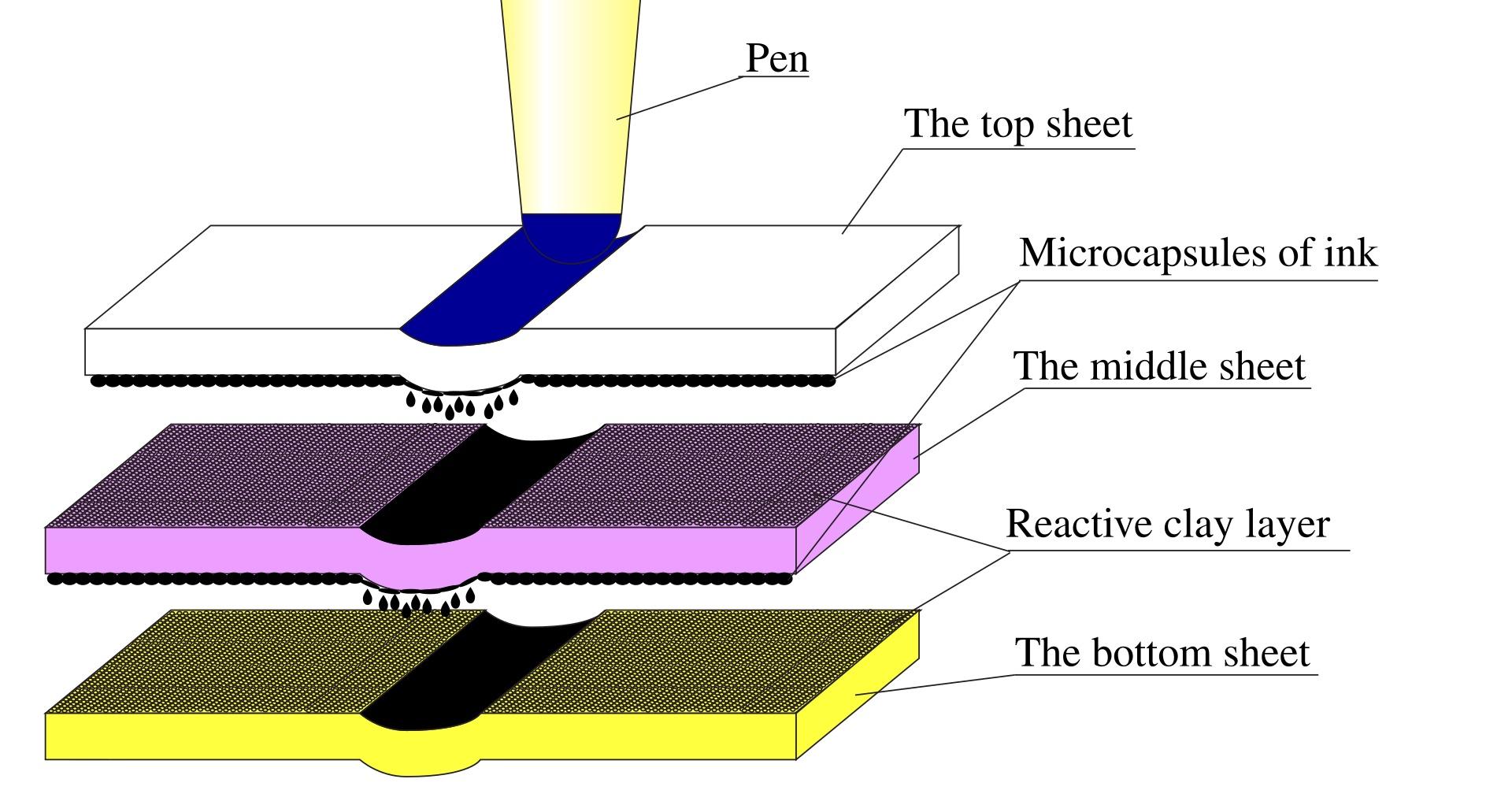
An impact printer, a typewriter and a ballpoint pen share the one property that matters here: each delivers a concentrated mechanical load to a small area of the top sheet. On a carbonless set that load is the whole of the printer's contribution. The mechanism deposits nothing on the lower sheets and never touches them. The stroke is a trigger; the image on ply two is manufactured locally, out of materials already lying in contact with each other.
This is why non-impact printing cannot make a carbonless copy: electrophotographic and inkjet processes form their image on the surface they address and apply no meaningful pressure beneath it, so the lower plies are never triggered. It is also why the part count of a set is bounded. Each ply absorbs some of the load and spreads what it passes on, so marks grow fatter and fainter down the stack until they stop being legible — not a rule about paper grades, but what happens to a point load travelling through compressible fibre.
What is actually inside the capsules
The coating on the back of the top sheet is neither ink nor pigment. The NIOSH hazard review of carbonless copy paper — DHHS (NIOSH) Publication No. 2001-107, still the most detailed public description of the construction — describes microcapsules between 3 and 6 micrometres in diameter, each enclosing a solution of colour former at roughly 2 to 6 percent in a high-boiling organic solvent. The solvent must boil high enough that the coating survives years in a warehouse without drying out, while staying mobile enough to wick the instant a capsule ruptures.
The colour formers NIOSH names are leuco dyes — leuco from the Greek for white — colourless in the closed form they are stored in. It lists triphenylmethanes, of which crystal violet lactone is the familiar example; xanthenes, the fluorans; and thiazines such as benzoyl leucomethylene blue. None of that liquid is visible. Rub the back of a top sheet hard against ordinary copier stock and you get an oily smudge and no colour at all.
| Coating | Which face it sits on | What the review lists |
|---|---|---|
| Capsule (CB) coating | Underside of a CB or CFB sheet | Microcapsules 3–6 micrometres across; a 2–6% solution of colourless colour former in a high-boiling organic solvent; binder; inert spacer particles ('stilts') of starch, floc or arrowroot, sized larger than the capsules |
| Developer (CF) coating | Top face of a CF or CFB sheet | An acidic developer — acid-treated reactive clays typical in Europe, phenolic resins typical in the United States and Japan |
| Colour formers named | Dissolved inside the capsules | Triphenylmethanes (e.g. crystal violet lactone); xanthenes (fluorans); thiazines (e.g. benzoyl leucomethylene blue) |
Source: NIOSH Hazard Review: Carbonless Copy Paper, DHHS (NIOSH) Publication No. 2001-107 — 'The Technology of CCP'

The developer ply, and why the halves are kept apart
The receiving surface carries an acidic developer, and the mark is the product of the two coatings meeting. In acid the leuco compound's closed lactone ring opens, its conjugated system extends, and it begins absorbing visible light. The developer is not a catalyst standing by; it is a reactant, deliberately coated onto a different sheet from the dye. That separation is the whole trick, and it is why every description of carbonless paper as 'invisible ink that develops on contact with air' is wrong in both halves of the sentence.
Which developer a sheet carries depends on where it was made. NIOSH records a geographic split — acid-treated reactive clays typical of European production, phenolic resins in the United States and Japan. Both are acidic solids dispersed in a binder and behave identically to a user; to a chemist, and to anyone studying occupational exposure, they are different materials, which is why the review distinguishes them.
Why a ream does not copy itself
Here is the question the mechanism as described cannot yet answer. A capsule coating and a developer coating spend their working life pressed face to face — in a pad, in a box, at the bottom of a full ream — and the sheet is sensitive enough to record a ballpoint stroke through four plies. Why does the weight of the paper above not develop the whole stack a uniform blue?
The answer is a component popular accounts almost universally omit. NIOSH describes inert spacer particles blended into the capsule coating, known in the trade as stilts: starch, floc or arrowroot, deliberately sized larger than the capsules. They stand proud of the coating and carry the load, so distributed static weight rests on the stilts while the capsules sit sheltered in the gaps beneath, uncompressed. A concentrated point load is another matter — a pen nib or a print wire exceeds locally what the stilts can bridge and crushes the capsules directly under it. The original record-sheet patent adds a related reason for discretising the fluid at all: in a crease, a crack propagates between capsules rather than through a continuous film.
CB, CFB, CF: how a set is built
Because the two reactive coatings live on different sheets, a multipart set cannot be assembled from one kind of paper. It is assembled from three, and the abbreviations naming them describe only which faces are coated. A three-part set is CB / CFB / CF; a four-part set is CB / CFB / CFB / CF. Every additional intermediate copy costs one more CFB sheet and one more increment of pressure loss.
| Ply | Expansion | Coating | Position |
|---|---|---|---|
| CB | Coated back | Capsules on the reverse face only; the front is plain writable paper | Top sheet — takes the pressure, keeps the original |
| CFB | Coated front and back | Developer on the up-facing side, capsules on the down-facing side | Any middle sheet — receives from above, transmits below |
| CF | Coated front | Developer on the top face only | Bottom sheet — receives, transmits nothing |
Plies are usually tinted in a fixed sequence so a clerk can identify a copy by colour, but that sequence is a convention of a market or an individual form printer rather than a standard. There is no universal meaning to a yellow second ply, and colour orders differ between countries and trades.
Where the mechanism came from — and what it did not invent
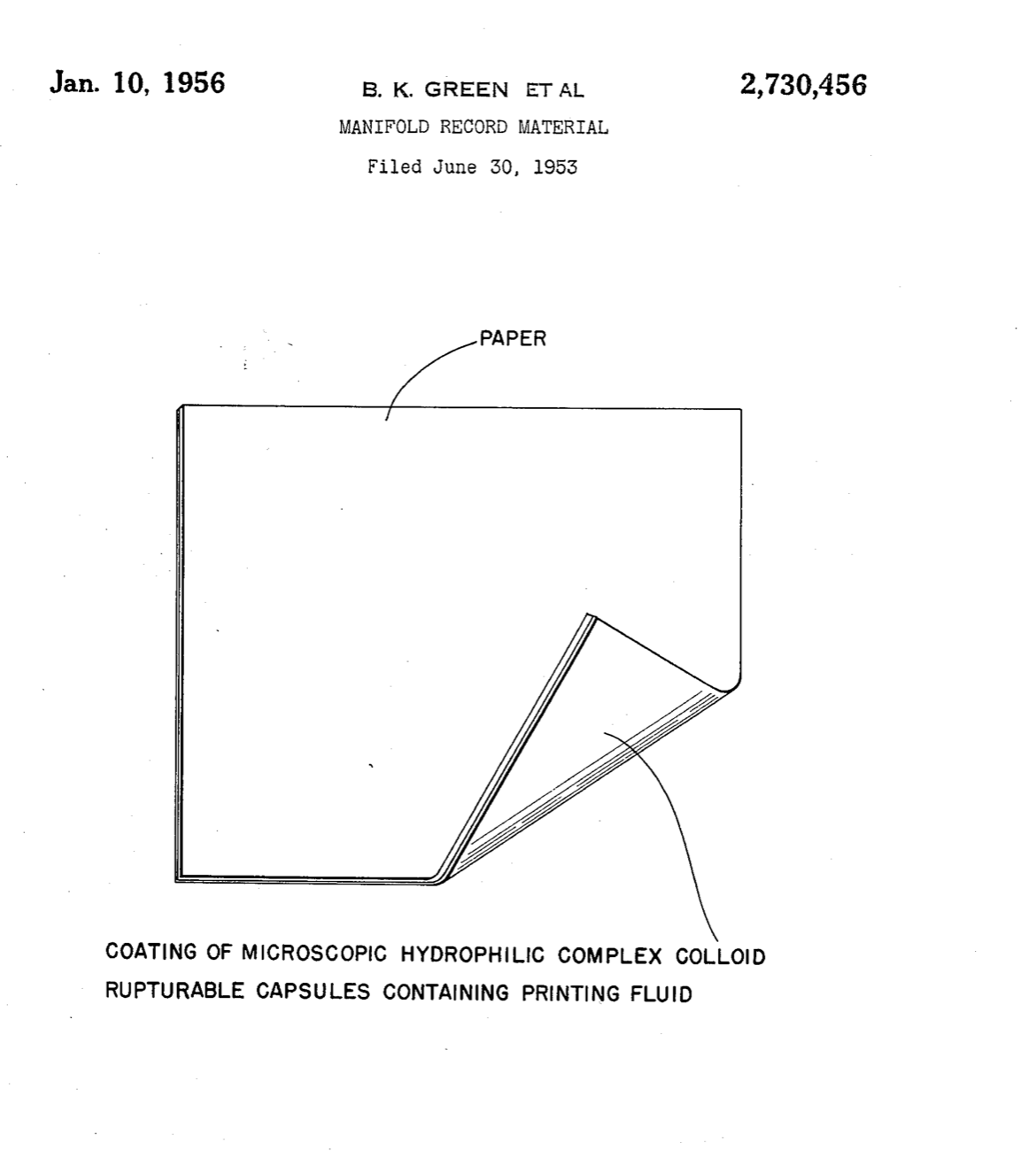
The founding documents are two United States patents filed on the same day, 30 June 1953, and assigned to The National Cash Register Company. US2730456, 'Manifold Record Material', names Barrett K. Green and Lowell Schleicher and issued on 10 January 1956; it covers the record sheet. US2800457, covering the encapsulation method rather than the sheet, names Green alone and issued on 23 July 1957. The split is worth stating, because the microencapsulation literature habitually cites 'Green, 1953' and drops Schleicher.
What the filings describe is the coacervate-walled capsule: microscopic pressure-rupturable capsules whose nucleus is an oily, water-immiscible printing fluid, enclosed in a gelled complex hydrophilic colloid shell formed by coacervation from two oppositely charged colloids in roughly equal proportion — gelatin and gum arabic in the preferred embodiment. US2730456 states explicitly that the enclosed fluid may carry colourless colour-reactants which mark only on contact with acid-sensitised paper. The chemistry described above is not a later reconstruction; it is in the 1953 filing, in the inventors' own words.
What the patents did not do is invent complex coacervation — a colloid phenomenon described long before anyone thought to coat it onto a business form, conventionally traced in the literature to Bungenberg de Jong and Kruyt in the late 1920s. The defensible claim for Green and Schleicher is narrower and more interesting than 'they invented microencapsulation': they made a coacervate-walled capsule manufacturable as a pressure-transfer record coating, and produced the first commercially successful microcapsule-based carbonless paper. Even 'the first paper that copied without carbon' outruns the evidence, since other pressure-sensitive and chemical-transfer record papers were being pursued and spirit and hectograph duplicating already existed.
Late 1920s
Complex coacervation is described in the colloid-chemistry literature, conventionally credited to Bungenberg de Jong and Kruyt.
30 June 1953
US2730456 (Green and Schleicher, the record sheet) and US2800457 (Green, the encapsulation method) are both filed, assigned to NCR. Appleton Papers' SEC filing dates ACPC's joint work with NCR — on the development and production of carbonless paper — to the same year.
1954
NCR PAPER is marketed by NCR and manufactured by Appleton Coated Paper Company. EPA dates the use of PCBs in the manufacturing emulsion from this year.
1956 and 1957
US2730456 issues on 10 January 1956; US2800457 issues on 23 July 1957.
1970–1971
NCR acquires Appleton Coated Paper Company; the Appleton Papers division is formed the following year, per the company's SEC filing. EPA dates the end of PCB use in the emulsion to 1971.
1987
OSHA asks NIOSH to review the health effects reported in connection with carbonless copy paper.
December 2000
NIOSH's hazard review is confirmed, published as DHHS (NIOSH) Publication No. 2001-107.
2017
EPA's case summary describes a consent decree ending NCR's litigation over the Lower Fox River Superfund site, with costs the agency puts above $200 million.
The name is a trade mark, not a description
NCR PAPER was a trade name, and NCR stood for the National Cash Register Company — the assignee named on the patents. 'No Carbon Required' is a gloss retro-fitted to the initials afterwards: widespread, serviceable, and not their documented origin. The term has since genericised, and 'NCR paper' is now used across the trade for carbonless stock from any manufacturer, naming a construction rather than a producer.
'Carbonless' is equally specific about what it denies. It names the absence of the interleaved carbon-coated tissue a manifold set previously required between plies, not the absence of carbon. The dyes, the solvent, the binders and the capsule walls are all organic chemistry, and vendors who advertise the stock as 'carbon-free' are borrowing a word from a different conversation.
Who actually made it, and the solvent that followed
One of the most durable errors in this history is that NCR manufactured carbonless paper. NCR marketed it and held the patents; Appleton Coated Paper Company manufactured it, and by ACPC's own filed account the two worked together from 1953 on both development and production. Appleton Papers' corporate history, set out in its SEC Form 10-K under disclosure obligations rather than in a brochure, dates ACPC's founding to 1907 and records that 'In 1953, ACPC began working with NCR Corporation on the development and production of carbonless paper' and that in 1954 NCR began marketing its NCR PAPER brand 'which ACPC manufactured'. The same section dates NCR's acquisition of ACPC to 1970, the formation of the Appleton Papers division of NCR to 1971 — through the merger of ACPC with Combined Paper Mills — and the 1978 acquisition of that division's assets from NCR by Appleton, then a subsidiary of B.A.T Industries. It is a company's account of itself — but a filed one, and it preserves a division of labour most retellings collapse.
Both names appear together in the United States public record because of the solvent. EPA's case summary for the Lower Fox River Superfund site states that NCR developed 'pressure responsive record materials' for carbonless copy paper, and that 'From 1954 to 1971, PCBs were used in the emulsion to manufacture NCR copy paper.' The PCBs were capsule-emulsion chemistry — the carrier, not the colour former — and are not present in modern stock. EPA attributes the release to both the manufacture of NCR paper and its later recycling by various paper mills, via numerous wastewater discharge points, and the 2017 consent decree left NCR as the sole work party for the remaining sediment cleanup, at a cost the agency estimates above $200 million. Estimates of the PCB mass there differ substantially between EPA's own documents and the state figures cited in the natural-resource-damage record, so any tonnage belongs to the document it came from rather than being quoted as the number.
Reading this back onto the printer
Return to the sentence this page set out to unpack — that an impact printer produces several copies in one pass — and it reads differently. The printer is not producing copies; it is delivering precisely located mechanical impulses into a stack of chemically prepared sheets, each of which manufactures its own image from its own coatings. The strike is a signal; the sheets are the device. That also explains the form set's odd persistence. Offices moving to non-impact output did not lose a printer feature, they lost the ability to address a substrate, and no driver setting could restore it. Wherever multipart carbonless sets survived, an impact mechanism survived alongside them — not because the printer was better, but because the paper still needed hitting.
Frequently asked questions
- Does the printer put ink on the second copy?
- No. The printer applies pressure to the top sheet only. The capsule coating on its underside ruptures under the stroke and releases a colourless solution, which reacts with an acidic developer coated on the top face of the sheet below. The copy is made by the two coatings, not by anything the printer deposits.
- What do CB, CFB and CF mean?
- They describe which faces are coated. CB is coated back — capsules on the reverse — and is the top sheet. CFB is coated front and back, developer facing up and capsules facing down, and serves as any middle sheet. CF is coated front, developer only, and is the bottom sheet. A three-part set is CB / CFB / CF.
- Why doesn't a stack of carbonless paper copy itself?
- Because of inert spacer particles called stilts. NIOSH describes starch, floc or arrowroot particles blended into the capsule coating and sized larger than the 3-to-6-micrometre capsules, so they stand proud of the surface and carry distributed static load. A concentrated point load from a pen or print wire exceeds what the stilts bridge locally and ruptures the capsules beneath it.
- Does NCR stand for 'no carbon required'?
- NCR was the National Cash Register Company, the assignee named on the 1953 patent filings. 'No carbon required' is a widely repeated gloss applied to the initials afterwards rather than their documented origin. The term 'NCR paper' has since genericised and is used for carbonless stock from any manufacturer.
Source transparency (7 sources)
These references support claims made in this entry. The archive uses verified institutional and public-domain sources only; see Source policy.
Sources consulted (7)
- US2730456A — Manifold Record Material (Green and Schleicher) — Google Patents / USPTO — assignee: The National Cash Register Company
- US2800457A — Oil-containing microscopic capsules and method of making them (Green) — Google Patents / USPTO
- NIOSH Hazard Review: Carbonless Copy Paper — DHHS (NIOSH) Publication No. 2001-107 — National Institute for Occupational Safety and Health / CDC (US federal, public domain)
- NIOSH Hazard Review: Carbonless Copy Paper — 'The Technology of CCP' (full-text transcription) — Wikisource transcription of the public-domain NIOSH original
- Case Summary: NCR Corporation Agrees to End Litigation and Complete PCBs Cleanup at Fox River Superfund Site — U.S. Environmental Protection Agency
- OSHA eTool — Hospitals: Administration: Carbonless Copy Paper — Occupational Safety and Health Administration
- Appleton Papers Inc. Form 10-K (FY2010) — corporate history section — U.S. Securities and Exchange Commission, EDGAR
Continue in the archive
Related reading
Guides · Intermediate
Impact Printing
Impact printing strikes an inked ribbon against paper by force — the category behind dot-matrix, daisy-wheel, and line printers, and multipart copies.
History · The impact-printing era
How Dot Matrix Printers Work
Dot matrix solved an office problem before it was a mechanism: cheap, durable, simultaneous multi-part copies created in the act of printing.
Guides · Intermediate
Dot-Matrix (Impact) Printer Ribbon
What a dot-matrix (impact) printer ribbon is: its woven-fabric and polymer-film types, how it transfers ink on impact, and its role in print quality.
Guides · Intermediate
Synthetic & Specialty Media
Reference on synthetic and specialty printing media: polymer and engineered substrates, their types and grades, how they are measured (ISO 216, 536, 2470, 2471)…