Key takeaways
- Early network printing's durable legacy was social: a queue created etiquette, precedence, and informal authority over the line.
- Spoolers and servers did not only sequence jobs; they relocated control over order from people at a device to a system and its administrator.
- The behaviours and expectations formed here outlived the specific hardware and became permanent assumptions about shared printing.
When a printer stopped belonging to one desk
The decisive moment in this story is not a wire being connected; it is a printer ceasing to be one person's and becoming everyone's. The instant a single device served many desks, something that had not existed before came into being: a line. A worker could no longer simply print, because someone else's work might be ahead of theirs. That sounds trivial and is not. A line is a social object as much as a technical one, and almost everything distinctive about shared office printing flows from the line rather than from the network beneath it.
The archive's account of office printing before Wi-Fi describes the wired topology that made shared devices reachable. This page takes up what happened among the people once they were sharing one — the part of the history that was about conduct rather than cabling.
The queue as a new office reality
The queue — defined in the archive's entry on the print queue — was a genuinely new feature of working life, not a technicality hidden inside a system. It made the order of work visible and contestable. A long job ahead of a short one meant the short one waited; a job submitted later but more urgent had no natural way to assert its urgency. The queue introduced, into the ordinary office, the small daily politics of any shared line: patience, frustration, the temptation to jump, and the question of whether jumping was acceptable.
What makes this historically significant is that the queue was not experienced as infrastructure. It was experienced as a situation among colleagues, and people responded to it the way they respond to any line — by forming norms.
Spoolers, servers, and who controlled the line
Underneath the social line sat a technical one. A spooler — the subject of the archive's entry on the print spooler — accepted jobs, held them, and released them to the device in order, so the device was never directly contended for. A server administered that arrangement for many users. The historically interesting consequence is about control rather than mechanism: deciding what printed next moved away from whoever was standing nearest the machine and toward the system and the person who administered it. Precedence stopped being something seized at the device and became something the system enforced and an administrator could shape.
This was a quiet transfer of authority. The queue did not only order jobs; it relocated the power to order them, from physical presence to systemic position — a shift whose broader workplace consequences the archive's evolution of office printing develops further.
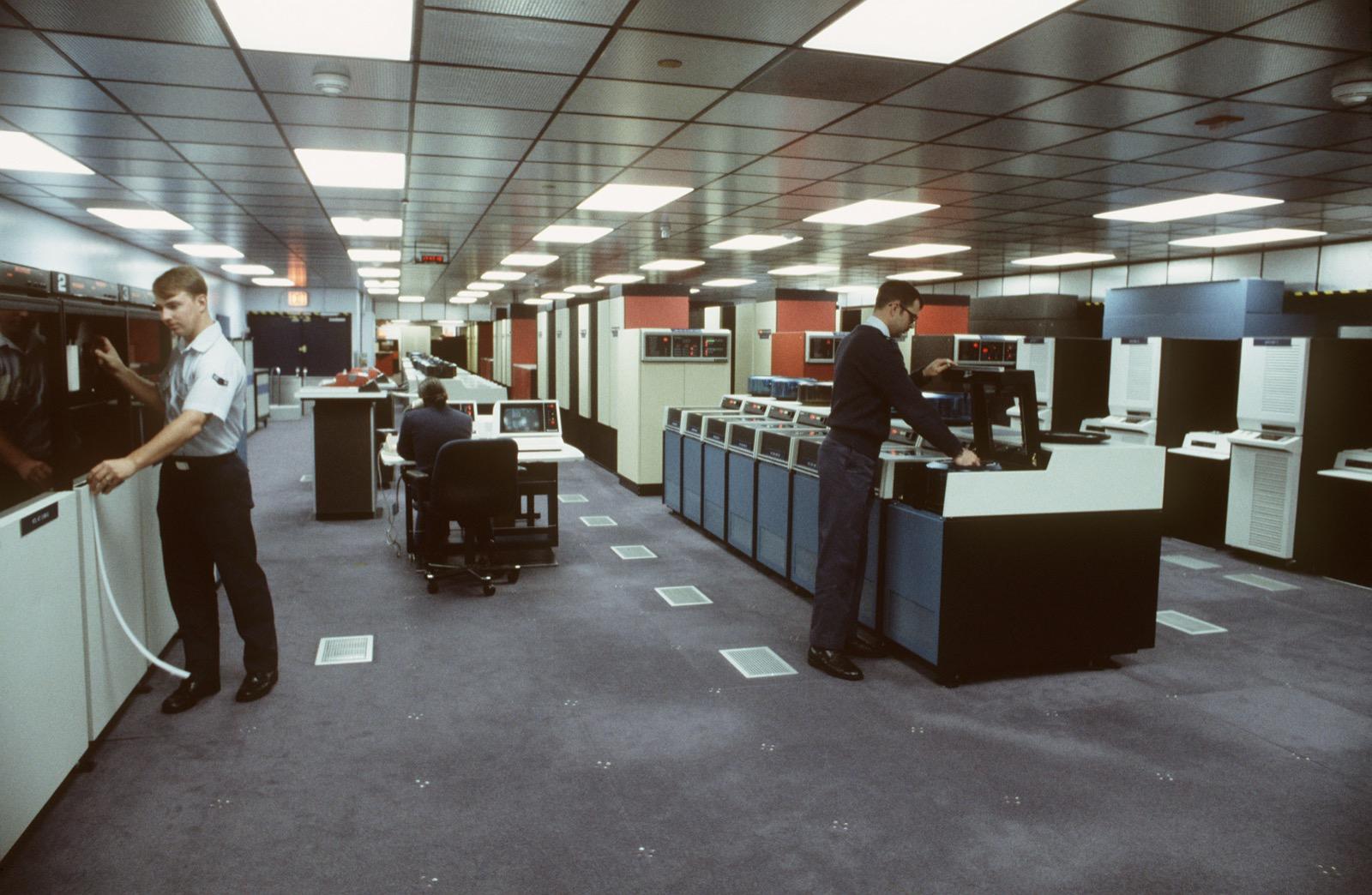

How sharing changed behavior and etiquette
Around the queue grew an unwritten etiquette that no system specified and everyone learned. Large jobs were, by custom, deferred or run at quiet times so as not to monopolise the line. Collecting promptly so output did not pile up, not disturbing other people's pages in the tray, and not casually cancelling work that was not yours became ordinary courtesies. Standing by the device for something urgent was a recognised, semi-legitimate way of asserting precedence the system did not grant. These norms were a social technology that grew up alongside the technical one to make a shared line tolerable.
The point worth holding is that this etiquette was emergent, not designed, and it was specific to sharing. It had no analogue in the per-desk arrangement because a private device needs no courtesy.
The reliability trade-offs of early networks
The arrangement that produced these norms also concentrated risk, and the etiquette partly existed because the consequences of disorder were now collective. When the device, the spooler, or the server faltered, it did not inconvenience one person; it stalled everyone whose work sat in the line, and a jammed or failed shared queue could halt a whole group's output at once. Sharing thus traded the per-desk world's redundancy — many small independent points of failure — for a single, efficient, but collectively critical one. The norms of restraint around the queue were, in part, a social response to the fact that careless behaviour now had shared cost.
What early network printing made permanent
The hardware of early network printing was superseded many times over, but its social product was not. Once people had learned that printing is a shared, queued, asynchronous act governed partly by courtesy and partly by a system, that understanding became the permanent default and every later arrangement inherited it. The expectation that one submits and waits rather than seizes, that large jobs are a collective consideration, that order is administered rather than grabbed — these outlived the specific spoolers and servers entirely. What the office kept, in the end, were the manners of the line: the deference toward someone else's job already in flight, the small habit of asking before sending two hundred pages, the acceptance that precedence belonged to the system. What it discarded was the hardware that first taught those manners.
Frequently asked questions
- Why describe early network printing as a social development rather than a technical one?
- Because its durable product was social. Connecting a device to many desks created a line, and the line produced waiting, courtesy, precedence, and informal authority. The hardware was superseded repeatedly; those norms about sharing a queue persisted and became the default.
- How did spoolers and servers change who controlled printing order?
- They moved control of precedence away from whoever stood nearest the device and into the system and its administrator. A spooler held and released jobs in order, so order became something the system enforced and could be shaped administratively rather than seized physically.
- Why did an unwritten printing etiquette emerge at all?
- Because sharing made disorder collectively costly. A failed or monopolised queue stalled a whole group, so customs — defer large jobs, collect promptly, do not cancel others' work — emerged as a social response to risk the per-desk arrangement never had.
Continue in the archive
Related reading
History · Decoupling the request from the print
Spoolers and Print Queues
Spooling solved an economic problem before a technical one: how to keep a slow, expensive printer fully used while never making a fast computer or its user wait.
Guides · Intermediate
What Is a Print Server?
What a print server does, why organisations use one, and how it centralises queues, drivers, and access.
Glossary · Definition
Print Spooler
The print spooler is the system component that accepts print jobs and manages them while they wait to print.
Glossary · Definition
Print Queue
The print queue is the ordered list of jobs waiting to print on a particular printer.